About Magnolia liliiflora Desr.
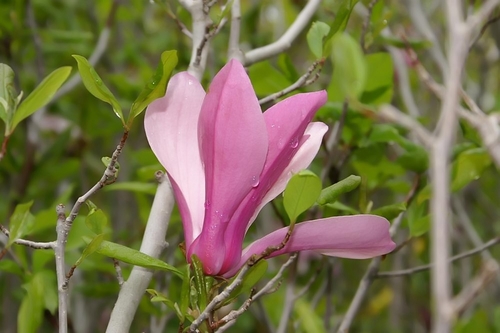
Magnolia liliiflora Desr. is a small tree that is native to southwest China, specifically Sichuan and Yunnan. It has been cultivated for centuries in other parts of China and in Japan. It goes by many common names, including Mulan magnolia, purple magnolia, red magnolia, lily magnolia, tulip magnolia, and woody-orchid. It was first introduced to English-speaking countries from cultivated plants grown in Japan, so it is sometimes also called Japanese magnolia, even though it is not native to Japan. Today, it is also planted as an ornamental plant in North America and Europe, though it is planted rather less often than its popular hybrid, which is discussed later. It is a deciduous shrub, rarely growing as a small tree, reaching up to 4 meters tall, which makes it smaller than most other magnolia species. It blooms heavily in early spring, producing large, showy pink to purple flowers before its leaf buds open. It is one of the slowest-growing tree species: young plants grow just 15 to 30 centimeters (6 to 12 inches) per year. The cultivar 'Nigra', which produces flowers that are much deeper in color than the wild species, has earned the Royal Horticultural Society's Award of Garden Merit. This species prefers acidic or neutral soil, and grows in full sun or light shade. It is one of the parent species of the popular hybrid saucer magnolia, Magnolia × soulangeana; the other parent is Yulan magnolia, Magnolia denudata.