About Magnolia grandiflora L.
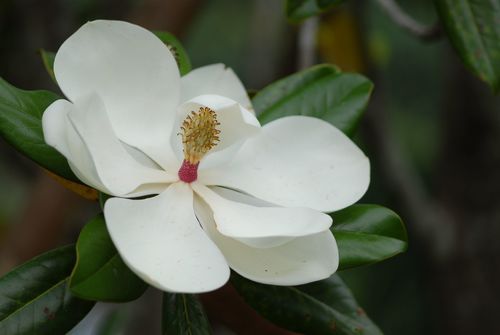
Magnolia grandiflora L., commonly southern magnolia, is a medium to large evergreen tree that may reach 37 m (120 ft) in height. It typically has a single trunk and a pyramidal shape. Its leaves are simple, broadly ovate, 12–20 cm long and 6–12 cm broad, with smooth margins. They are dark green, stiff, and leathery, often covered in yellow-brown scurfy pubescence on their undersides. The species produces large, showy, fragrant white flowers with a lemon-citronella scent that can measure up to 30 cm across. Each bloom has 6 to 12 waxy petals, emerging from twig tips on mature trees in late spring. After pollination, it forms a rose-colored ovoid polyfollicle fruit, approximately 7.5–10 cm long and 3–5 cm wide. Exceptionally large specimens have been recorded in the far Southern United States. The national champion specimen in Smith County, Mississippi, stands 37 m (121 ft) tall. Other recorded specimens include a 35 m tall tree with a 5.4 m (17.75 ft) circumference at breast height from the Chickasawhay District of De Soto National Forest, Mississippi, documented in 1961, and a 30 m tall tree from Baton Rouge, Louisiana, with an 18 ft circumference at breast height.
Southern magnolias are native to the Southeastern United States, ranging from Virginia south to central Florida, and west to East Texas. They grow on the edges of bodies of water and swamps, alongside sweetgum (Liquidambar styraciflua), water oak (Quercus nigra), and black tupelo (Nyssa sylvatica). The species' range is strongly correlated with low minimum winter temperatures. In sheltered habitats it grows into a large tree, but it develops as a low shrub on coastal dunes. It is killed by summer fires, and does not occur in regularly burned habitats. In Florida, it can be found in multiple shaded ecological areas with well-draining soils, including hummocks, ravine edges, slopes, and wooded floodplains. While it prefers sites with higher moisture, it cannot tolerate prolonged inundation. It also grows on sandhills in maritime forests alongside live oaks and saw palmetto (Serenoa repens). Outside its historic native range, it has escaped cultivation and naturalized in the tidewater area of Virginia and in scattered other locations in the eastern United States. Along with other magnolia species, southern magnolia can survive the cool winters of the British Isles, though its growth is slow due to a lack of summer heat. It was introduced to Great Britain in 1728, and has become a popular ornamental tree in some areas there.
Ecology: M. grandiflora can produce seed by 10 years of age, with peak seed production occurring closer to 25 years of age. Around 50% of its seeds are able to germinate, and seeds are dispersed by birds and mammals. Squirrels, possums, quail, and turkey are known to eat the seeds.
Cultivation and uses: North American plant collector Mark Catesby brought M. grandiflora to Britain in 1726, after which it entered cultivation and overshadowed the earlier introduced Magnolia virginiana. It was also collected by French botanists near the Mississippi River in Louisiana and brought to France. Philip Miller gave a glowing description of the species in his 1731 work The Gardeners' Dictionary. One of the earliest European cultivators of the tree was Sir John Colliton of Exeter, Devon; gardeners used scaffolding and tubs to work around his tree, and propagated branches via layering. The propagated daughter plants originally sold for five guineas each, later dropping to half a guinea. The species is often planted on university campuses, where it is allowed to grow into a large tree either keeping its lower branches, or with lower branches removed to display its bare trunk. It is also espaliered against walls, which improves its frost hardiness. It is commonly planted ornamentally in urban areas because it resists air pollutants such as sulfur dioxide.
United States cultivation: M. grandiflora is a very popular ornamental tree throughout its native range in the coastal plain of the Gulf and South Atlantic states. Grown for its attractive shiny green leaves and fragrant flowers, it has a long history in the Southern United States. Many large, very old specimens grow in subtropical port cities including Houston, New Orleans, Mobile (Alabama), Jacksonville (Florida), Savannah (Georgia), Charleston (South Carolina), and Wilmington (North Carolina). M. grandiflora is the state tree of Mississippi and the state flower of Louisiana. It is also cultivated as far north as coastal New Jersey, Connecticut, Long Island (New York), Delaware, most of the Chesapeake Bay region in Maryland, and eastern Virginia. On the U.S. West Coast, it can be grown as far north as the Vancouver, British Columbia, Canada area, though cooler West Coast summers slow its growth compared to the East Coast. In the interior U.S., cold-hardy cultivars have grown successfully as far north as Louisville, Kentucky and Cincinnati, Ohio, where a sizable population exists. Further north, few long-term established specimens are known, due to severe winters and/or lack of sufficient summer heat. Its seeds are reported to promote health and prevent conditions including high blood pressure, heart disturbances, and epilepsy. M. grandiflora is also grown in parts of Mexico, Central America, South America, and parts of Asia.
Until early 2018, an iconic southern magnolia planted by President Andrew Jackson nearly 200 years earlier grew near the South Portico of the White House. It was reputedly grown from a seedling taken from Jackson's Tennessee plantation, The Hermitage. It was the oldest tree on the White House grounds, and was famous enough to appear for decades on the back of the $20 bill as part of the view of the South Front. A tradition developed of giving cuttings or seedlings grown from this tree: Ronald Reagan gave a cutting to his Chief of Staff Howard Baker upon his retirement, and Michelle Obama donated a seedling to the "people's garden" of the U.S. Department of Agriculture. Since the 1940s, after the tree suffered a gash that caused large-scale trunk rot, it had been supported by metal poles and cables. In 2017, on advice from the National Arboretum, the decision was made to cut down and remove the magnolia, because its trunk was extremely fragile and its supports had failed. Offshoots from the Jackson magnolia were saved, grown to up to 10 ft, and one was planted in the original tree's place.
Southern magnolia is recommended for seashore plantings in windy areas with low levels of salt spray. At the northern limits of its cultivation, foliage will bronze, develop blotches, and burn during severe winters, especially when grown in full winter sun, but most leaves stay on the tree until they are replaced by new foliage in spring. In climates where the ground freezes, winter sun causes more damage than cold itself. In the Northern Hemisphere, the south side of the tree experiences more leaf damage than the north side. Two leaf form variants are recognized: one with white leaf undersides, and one with brown leaf undersides. Brown undersides are claimed to be linked to greater cold hardiness, but this claim has not been proven to date. Once established, southern magnolia is drought tolerant, and is the most drought tolerant of all Magnolia species. Its heavy leaves fall year-round from the crown interior, forming a dense cover over the soil surface, and the leaves have been used in decorative floral arrangements. A waxy coating on the leaves makes them resistant to damage from salt and air pollution.
In the United States, southern magnolia, along with sweetbay (Magnolia virginiana) and cucumbertree (Magnolia acuminata), is commercially harvested for lumber. Lumber from all three species is simply called magnolia, which is used for furniture, boxes, pallets, venetian blinds, sashes, doors, and as veneer. Southern magnolia has yellowish-white sapwood and light to dark brown heartwood tinted yellow or green. Its usually straight-grained wood has uniform texture with closely spaced growth rings. The wood ranks moderate in heaviness, hardness, and stiffness, moderately low in shrinkage, bending strength, and compression strength, and moderately high in shock resistance. In the Southeastern United States, its use has been replaced by the wider availability of harder woods.