About Magnolia fraseri Walter
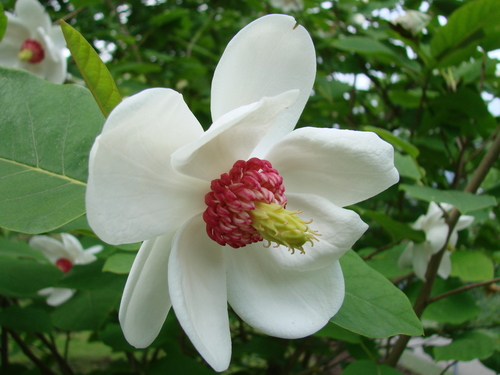
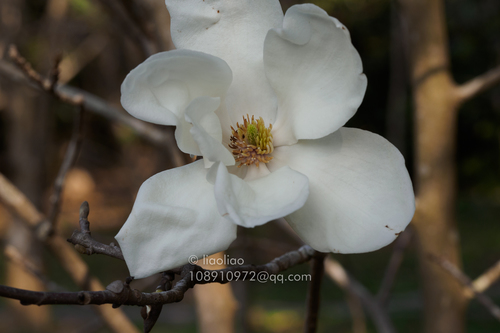
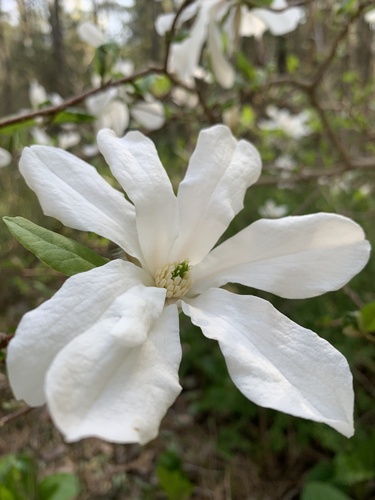
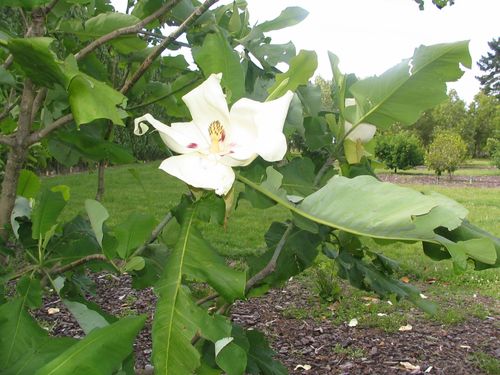
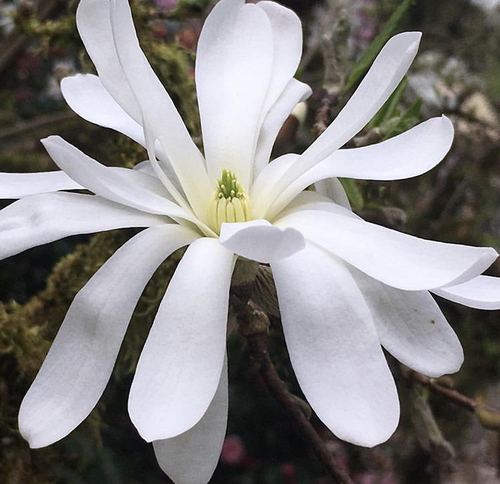
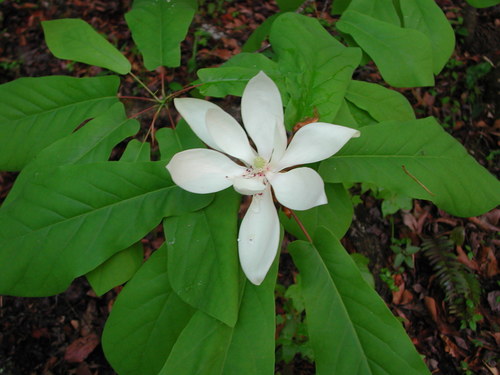
Fraser's magnolia, whose scientific name is Magnolia fraseri Walter, is named after Scottish botanist John Fraser. It is a small, deciduous tree that grows to 14 m (40 ft) tall. It branches from its base, has a fragrant scent, and has brown bark with a warty or scaly texture. Its leaves are quite large, measuring 15–25 cm long, and rarely reach up to 53 cm; they are 8–18 cm broad, and rarely reach up to 29 cm. Each leaf has a pair of auricles, also called ear-lobes, at its base and an entire smooth margin; the upper leaf surface is green, while the lower surface is glaucous blue-green. The tree produces showy white flowers that are 16–25 cm in diameter, with nine tepals. The flowers open in late spring or early summer, after new foliage has developed. Its fruit is a woody, oblong, cone-like structure, like that of all magnolias, that measures 6.5–12 cm long. The fruit is covered in small pod-like follicles, each holding one or two red seeds. When the seeds are ripe, they hang out from the fruit cone attached by a slender thread. A full good seed crop only occurs about every 4 to 5 years. This species reproduces both via seed and vegetative sprouts. Wildlife eats the tree's fruit, which helps disperse its seeds. In the Appalachian Mountains, Fraser's magnolia is a popular nest tree for the northern flying squirrel. It grows best in rich, moist, well-drained soil. Its very large showy white flowers and large-leaved, coarse-textured foliage make it an attractive ornamental tree, but it has little other commercial value. It is sometimes cultivated in North America as a native alternative to exotic magnolia species, and can be grown quite far north of its natural range when grown in conditions favorable to its growth. There are two recognized varieties of Magnolia fraseri: Magnolia fraseri var. fraseri, which is native to the Appalachian Mountains, and Magnolia fraseri var. pyramidata (Bartram) Pampanini, which originates from the Coastal Plain. The common vernacular name for Magnolia fraseri var. pyramidata is pyramid magnolia.