About Magnolia acuminata (L.) L.
Magnolia acuminata (L.) L. has several common names: cucumber tree (often written as the single word "cucumbertree"), cucumber magnolia, or blue magnolia. It is one of the largest and most cold-hardy magnolia species. This large forest tree is native to the Eastern United States and Southern Ontario, Canada. It typically grows as scattered individual specimens rather than forming dense groves. Its native range centers primarily on the Appalachian belt, including the Allegheny Plateau and Cumberland Plateau, and extends north into western Pennsylvania and New York. It also has many disconnected outlying populations across most of the southeastern United States, plus a few small populations in Southern Ontario. In Canada, this species is listed as endangered and protected under the Canadian Species at Risk Act. In 1993, the North American Native Plant Society purchased Shining Tree Woods to preserve a stand of Magnolia acuminata, a stand also known as "The Shining Tree".
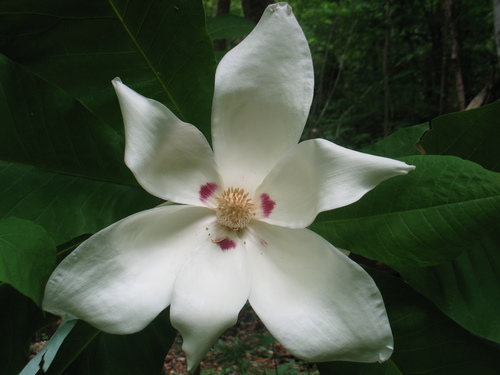
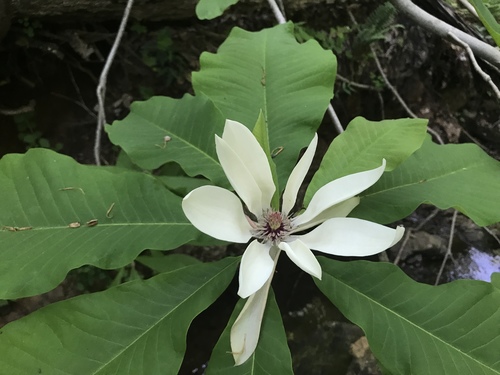
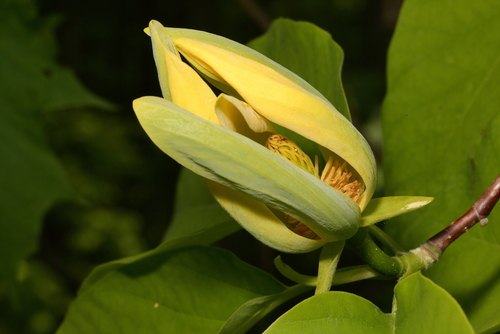
Its leaves are deciduous, simple, and arranged alternately along branches. They are oval to oblong, measuring 12–25 centimetres (4.7–9.8 in) long and 6–12 centimetres (2.4–4.7 in) wide, with smooth margins and a downy texture on the underside. Leaves take two forms: they may be acuminate at both ends, or moderately cordate at the base; cordate-based leaves usually only form on the upper sections of the tree. Unlike most magnolias, the flowers of Magnolia acuminata are not showy. They are typically small, yellow-green, and grow high in the tree, blooming from April through June. The species name "acuminata" comes from the pointed tip of its leaves; "acuminate" means tapering to a fine point. Its common name "cucumber tree" refers to the unripe fruit, which is green and often shaped like a small cucumber. When mature, the fruit turns dark red, measures 6–8 centimetres (2.4–3.1 in) long and 4 centimetres (1.6 in) wide, and individual carpels split open to release 10–60 bright red seeds per fruit. Ripe fruit can also be a striking reddish orange color.
Cucumber trees make excellent shade trees for parks and gardens, but they are not recommended for use as street trees. When grown in cultivation, they usually only reach 15–20 m (49–66 ft) tall, though they can grow to over 30 m (98 ft) tall in ideal forest conditions. They can grow to be quite large: the United States national (and presumed world) champion specimen in Stark County, Ohio measures 2.4 m (eight feet) in diameter and 29 m (96 ft) tall. They grow best in deep, moist, well-drained, slightly acidic soils, though they are also tolerant of alkaline soils. They are difficult to transplant because of their coarse, fleshy root system. For best results, they should be planted shallowly, moved in early spring, and transplanted with a large intact soil ball around the roots. In the timber trade, the wood of this species is interchangeable with the wood of the related tuliptree (Liriodendron tulipifera). Magnolia acuminata has been used in breeding new hybrid varieties that inherit its yellow flower color and cold hardiness. It is also categorized as a pollinator plant that supports and attracts bees and butterflies, and it acts as a host plant for butterflies by providing food for their larval stage.