About Magicicada neotredecim Marshall & Cooley, 2000
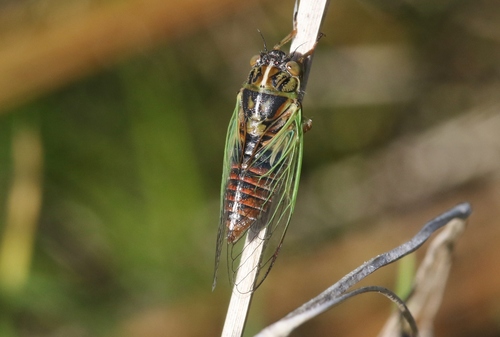
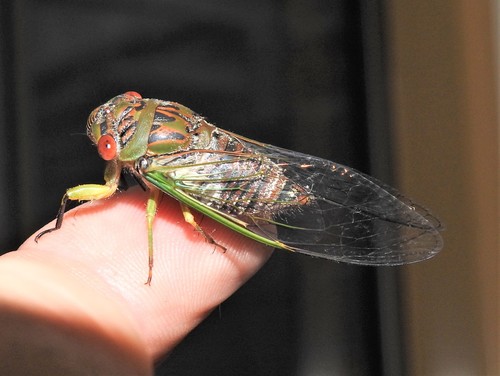
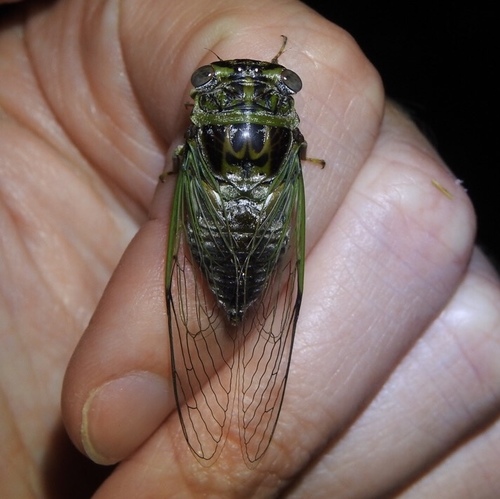
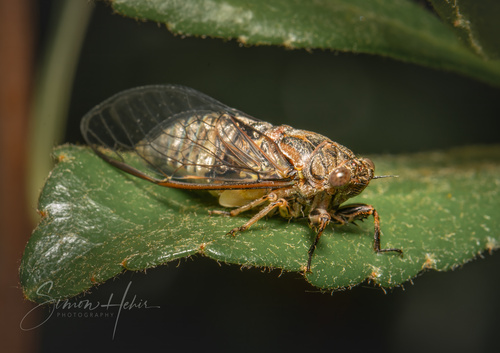
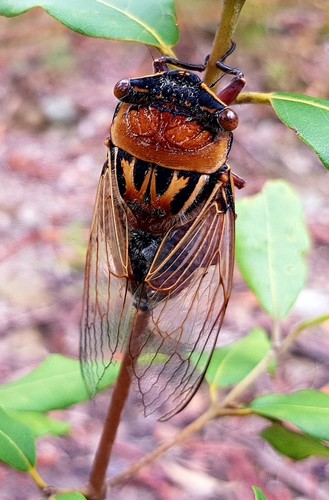
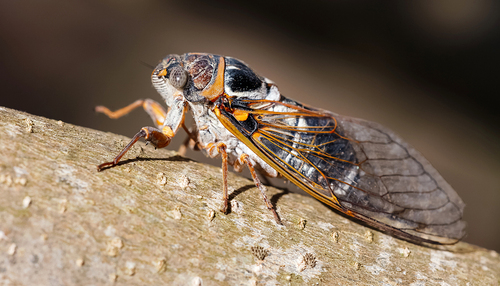
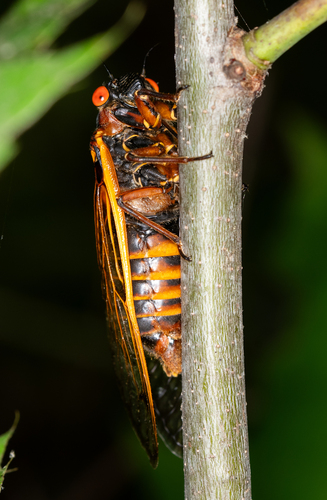
Magicicada neotredecim is the most recently discovered species of periodical cicada. Like all other Magicicada species, M. neotredecim has reddish eyes, reddish wing veins, and a black dorsal thorax. This species follows a 13-year life cycle, and it appears to be most closely related to the 17-year periodical cicada species Magicicada septendecim. Both M. neotredecim and M. septendecim are marked by broad orange stripes on the abdomen and share a unique high-pitched song described as resembling the phrases "weeeee-whoa" or "Pharaoh." The only difference between these two species is the length of their life cycles. Another closely related 13-year species, Magicicada tredecim, differs only very slightly from M. neotredecim. For many years, the two were considered to be a single species, with only slight differences in abdomen color and mitochondrial DNA noted. These differences led researchers to suggest there was a zone of hybridization or introgression between 13-year and 17-year -decim populations. In 1998, scientists studying recordings of the chorus sound of Brood XIX identified that the low-pitch component of the chorus held two separate peak frequencies in some midwestern populations. These peaks corresponded to the songs of two sympatric 13-year species related to M. septendecim. Follow-up experiments confirmed the existence of two separate populations of female cicadas, each of which responded selectively to only one of the two male song frequencies. Because of their extensive similarities, M. neotredecim, M. tredecim, and M. septendecim are often grouped together and referred to as "decim periodical cicadas." Periodical cicadas are sorted into broods based on their emergence year and life cycle length. The three other known 13-year Magicicada species—M. tredecim, M. tredecassini, and M. tredecula—are found in all three of the currently extant 13-year broods: Brood XIX, which emerged in 2011; Brood XXII, which emerged in 2014; and Brood XXIII, which emerged in 2015. M. neotredecim was first discovered in 1998 within Brood XIX, where it occurs in the northern portion of the brood's range. It has a narrow range of overlap with M. tredecim, which is found further south. M. neotredecim has also been observed in Brood XXIII, but it has not been found in Brood XXII. The median life cycle of M. neotredecim, from egg to natural adult death, is around thirteen years. Individual life cycles can range anywhere from nine years to seventeen years.