About Magicicada cassini (Fisher, 1852)
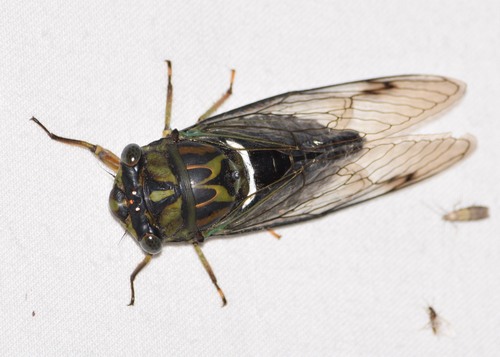
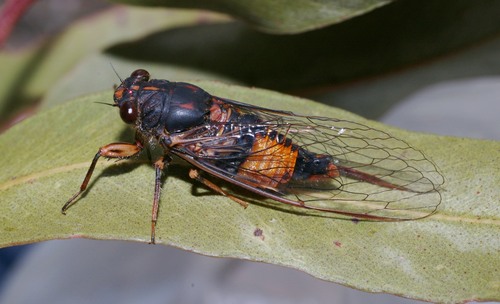
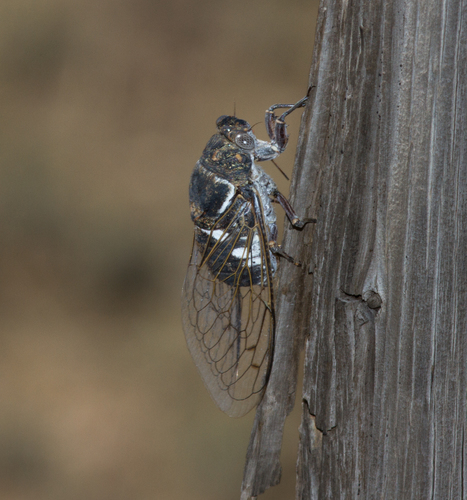
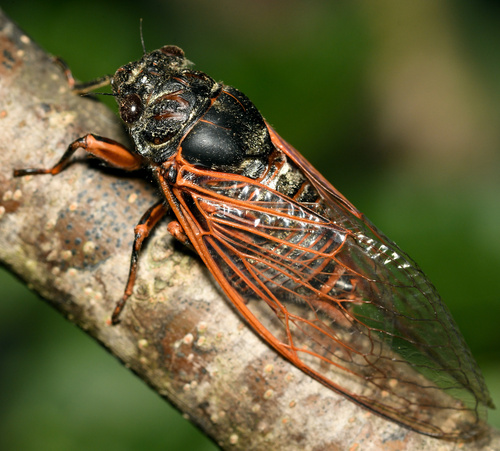
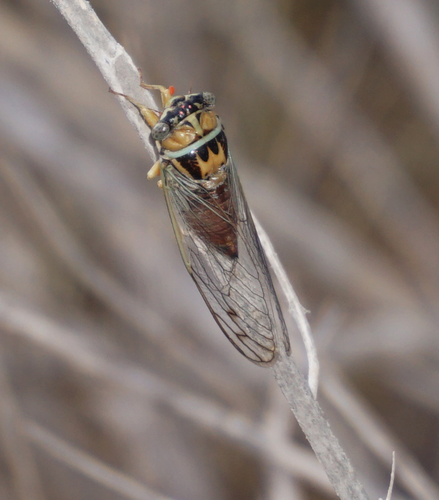
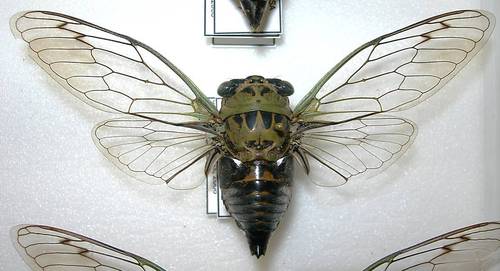
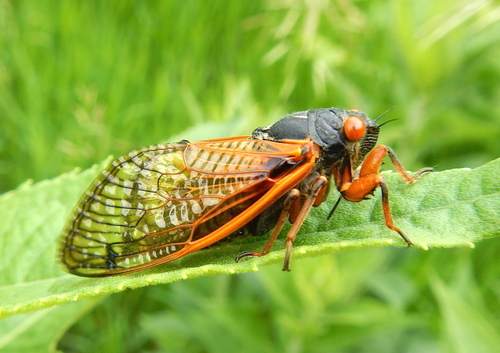
Adult Magicicada cassini are very similar in appearance to other periodical cicadas. Measuring from the front of the head to the tip of the wings folded over the abdomen, adults are between 24 and 27 mm (0.94 and 1.06 in) long. They have a black head, large red eyes, and a black pronotum, with only a narrow orange band along the edge of the sternites. Their abdomen is black, legs are orange, and wings are translucent with orange veins and dusky markings near the tips. Magicicada cassini is endemic to North America, with a range extending across the northern belt of the United States and southern Canada. These cicadas are true bugs. After emerging from underground, adult M. cassini feed on sap sucked from trees and shrubs. Large groups of males sing in unison to attract females. Their call lasts two to four seconds, consisting of a series of ticks followed by a drawn-out buzz that rises and falls in pitch. At the end of each chorus, males move to a new perch before starting their song again. After mating, females insert their ovipositors into plant shoots to lay eggs. The eggs hatch around two months later, and first instar nymphs drop to the ground, move underground, and feed by sucking xylem sap from small rootlets. This sap has very low nutritional value, so nymphs grow very slowly. Over a period of seventeen years, nymphs moult five times and move to larger roots deeper in the soil as they grow. Finally, all nymphs tunnel up through the soil to emerge into the open air, then climb vegetation and shed their skins for the final time to become adults. While each population typically has a seventeen-year life cycle and emerges in synchrony, past environmental events have occasionally disrupted this pattern. As a result, several different broods exist across the insect's range, and these broods emerge in different calendar years. In fact, the overall life cycle of M. cassini can range from thirteen to twenty-one years. Different broods have been assigned numbers; the most recent emergence of Brood X occurred in May and June 2021, in Delaware, Georgia, Illinois, Indiana, Kentucky, Maryland, Michigan, North Carolina, New Jersey, New York, Ohio, Pennsylvania, Tennessee, Virginia, Washington, D.C., and West Virginia. Many broods have a sub-brood that emerges a few years before the main regular brood. The Brood XIII sub-brood in the Chicago area emerged four years early, in 2020.