About Magallana gigas (Thunberg, 1793)
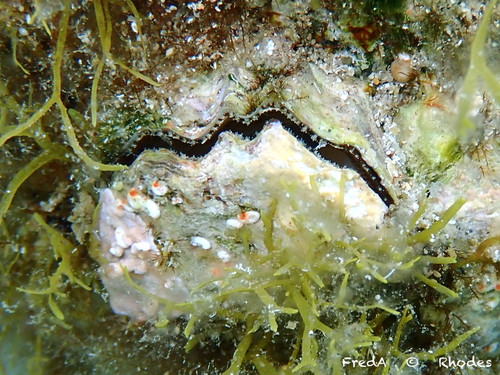
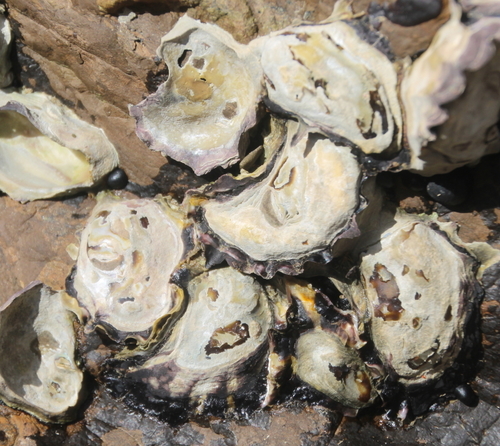
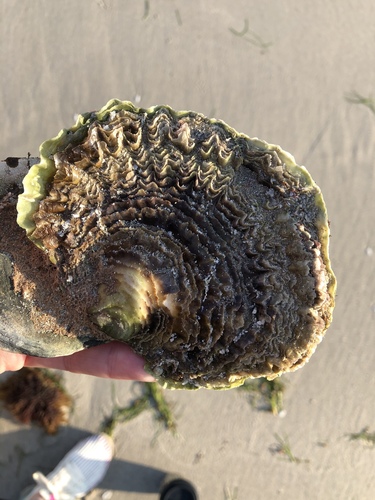
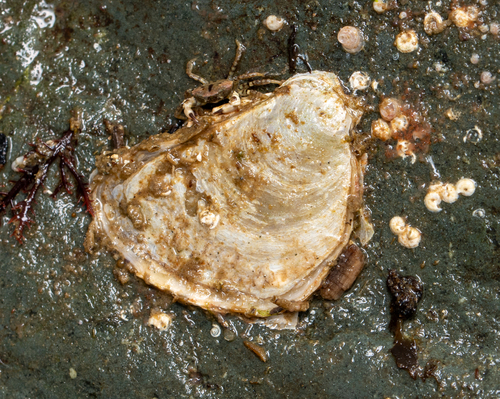
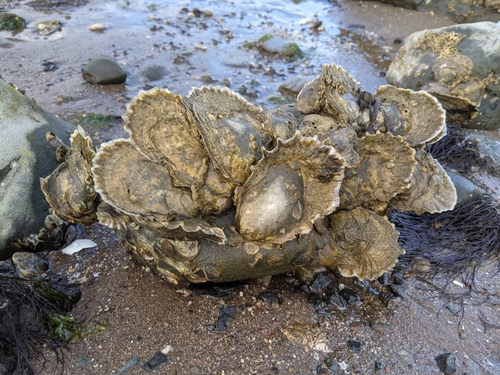
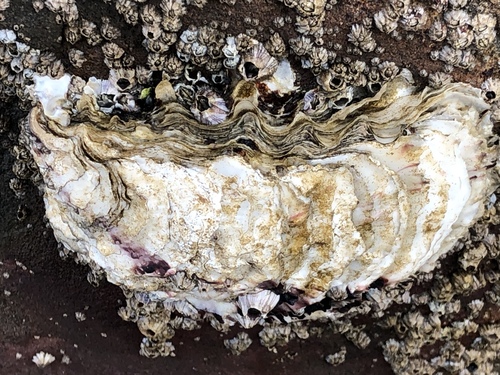
Magallana gigas, commonly known as the Pacific oyster, has a shell that varies greatly in form depending on the environment where the individual attaches. This species has large, rounded radial folds that are often extremely rough and sharp. The two shell valves differ slightly in size and shape, with the right valve being moderately concave. Shell color is variable, but is most often pale white or off-white. Mature specimens measure between 80 and 400 mm in length. Magallana gigas is an estuarine species, but may also occur in intertidal and subtidal zones. Individuals prefer to attach to hard or rocky surfaces in shallow or sheltered waters up to 40 m deep, but will attach to muddy or sandy areas when preferred habitat is scarce. Pacific oysters can also grow on the shells of other animals. Larvae often settle on the shells of adult oysters, and large groups of oysters can grow together to form oyster reefs. The optimal salinity range for Pacific oysters is between 20 and 35 parts per thousand (ppt), and the species can tolerate salinities as high as 38 ppt; however, reproduction is unlikely to occur at 38 ppt. This species is also very tolerant of a wide range of temperatures, and can withstand temperatures from −1.8 to 35 °C. Pacific oyster larvae are planktotrophic, and measure about 70 μm at the prodissoconch 1 stage. Larvae move through the water column using a larval foot to search for suitable settlement locations. They can spend several weeks in this mobile larval phase, and the length of this period depends on water temperature, salinity, and food supply. Over these weeks, larvae can disperse long distances via water currents before they undergo metamorphosis and settle as small spat. Like other oyster species, once a Pacific oyster larva finds a suitable habitat, it attaches permanently to it using cement secreted from a gland in its foot. After settlement, the larva metamorphoses into a juvenile spat. Growth is very rapid under optimal environmental conditions, and individuals reach market size in 18 to 30 months. Unharvested Pacific oysters can live up to 30 years. Growing more Pacific oysters requires installing increasing numbers of growing frames along shorelines, which has led to claims that this changes the natural character of beaches and may put other shore users at risk. During preparations for the 2020/2021 Tokyo Summer Olympics, 14 metric tons (15 short tons) of Magallana gigas were found growing on canoeing and rowing competition equipment. Removing this accumulated oyster biomass cost US$1,280,000/£930,000.