About Maesa lanceolata Forssk.
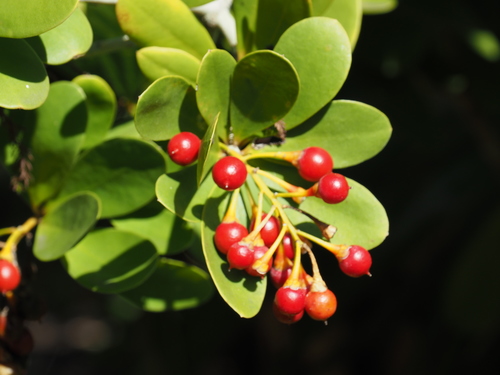
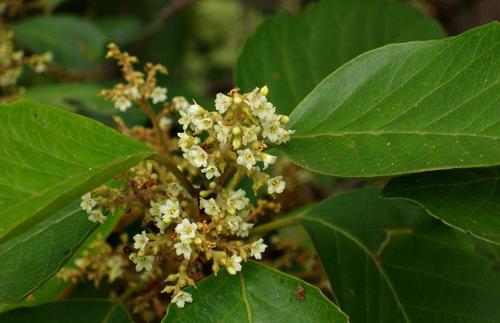
Maesa lanceolata Forssk. grows as either a shrub or a tree. Tree forms can reach 10 meters in height, and have been observed growing up to 20 meters tall. Its bark is grey, brown to reddish-brown, and vertically fissured. The inner bark slash is pink, turning brown, and produces a dark reddish exudate. Its leaves have petioles that can grow up to 4 cm long. Leaf blades are elliptical to lanceolate in shape, reaching up to 16 cm in length and 7 cm in width. Leaf margins are typically serrate to crenate, with an acute apex and a rounded to obtuse base. Flowers are numerous, white to yellowish, and arranged in shortly pedunculate axillary panicles. Fruits are yellow, globose, and contain up to 20 seeds. This species occurs in Tropical Africa and the Arabian Peninsula, where it is most commonly found in montane forest and gallery forest habitats. The yellow fruits of Maesa lanceolata are eaten by the Yellow-whiskered greenbul and the olive-breasted mountain greenbul, but they can be toxic to humans. Even though it is considered toxic to humans, extracts of Maesa lanceolata have been used by various local communities to treat a range of ailments. In East Africa, native healers use decoctions made from root and fruit extracts to treat cholera, tapeworm infections, and sore throat.