About Madracis auretenra Locke, Weil & Coates, 2007
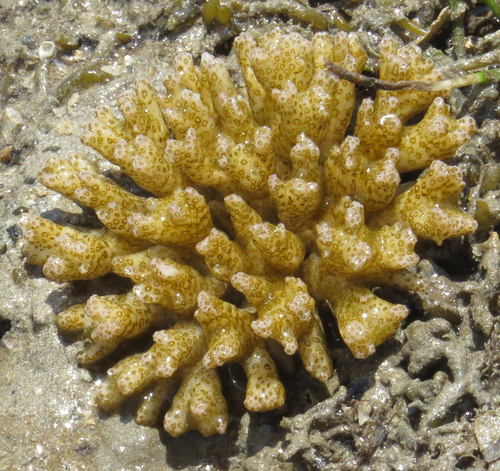
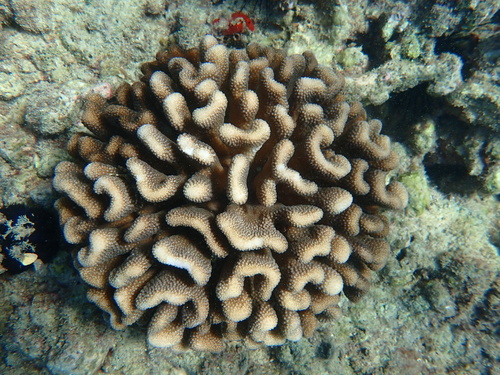
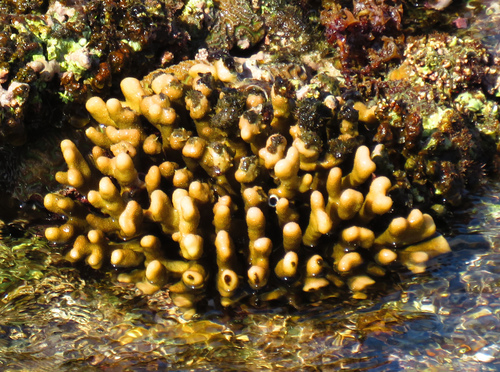
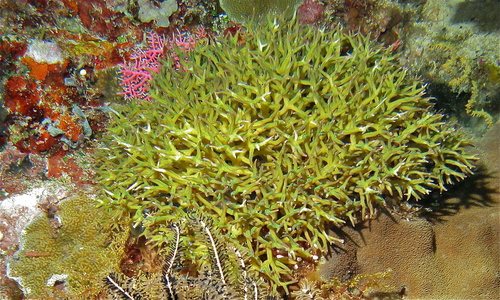
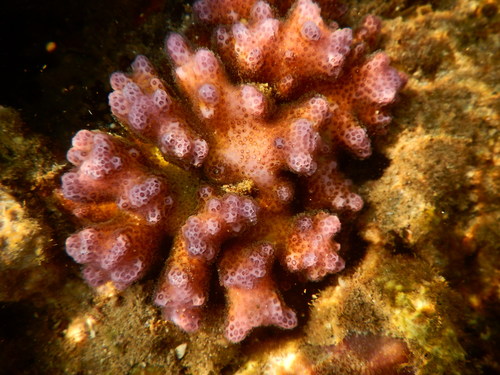
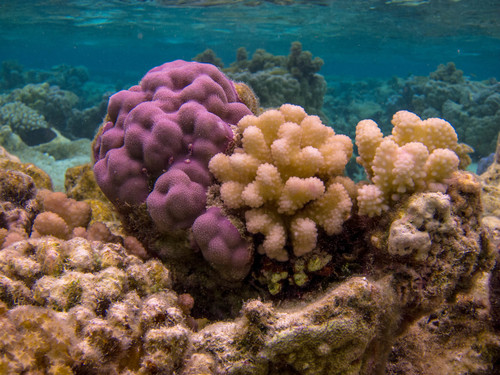
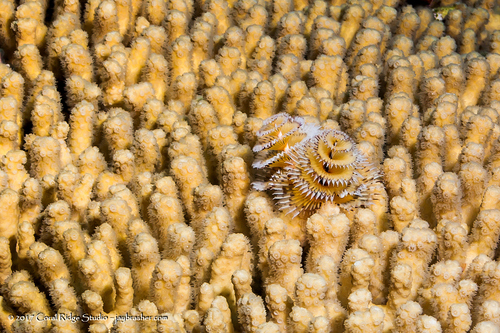
Madracis auretenra forms hemispherical clumps that can measure one metre or more across. Each colony is made up of densely packed, cylindrical branches with blunt, finger-like tips. In fore-reef habitats, the branches are slender; in back-reef and lagoon habitats, branches are more robust and the resulting clumps are larger. Like most coral species, this species builds colonies from hard skeletal material, which is normally covered by a thin layer of living tissue called the coenosarc. However, M. auretenra is unusual in this respect: as the coral grows, the coenosarc progressively dies back on the lower sections of the branches, leaving the skeleton bare, and only the tips of the branches remain covered in living tissue. The corallites of this species have a diameter between 1.1 and 1.6 mm (0.04 to 0.06 in) and have at least ten septa, and the coral itself is bright yellow. Madracis auretenra is a zooxanthellate coral, that hosts symbiotic single-celled protists within its tissues. The symbionts provide the products of photosynthesis to the coral, and in turn use some of the coral's waste products. To supplement this food source, the coral's polyps extend their tentacles to catch zooplankton, feeding primarily on the larvae of crustaceans, polychaete worms, and arrow worms. M. auretenra is a hermaphrodite: individual colonies contain both male and female gonads. The release of gametes into the sea is tied to the phase of the moon and other environmental factors. After fertilisation, planula larvae become part of the plankton, before eventually settling on the seabed and undergoing metamorphosis into new polyps. In some cases, M. auretenra has been observed retaining gametes on its mesenteries and pseudo-brooding the larvae for a short period before releasing them into the sea. M. auretenra also reproduces easily through fragmentation, a form of asexual reproduction. Even relatively small fragments of the coral can survive and grow into new colonies; in trial studies, fragment survival rates ranged between 29 and 81%. Survival rates were highest in fore-reef environments, and lowest in lagoons, where sedimentation levels are higher. Madracis auretenra has been used as a study organism to investigate the effects of ocean acidification on corals. Through experiments manipulating the composition of modified seawater holding the corals, researchers found that bicarbonate concentration in water is more relevant than carbonate or aragonite concentration, which had previously been considered the most important predictive factors.