About Madoqua kirkii damarensis (Günther, 1880)
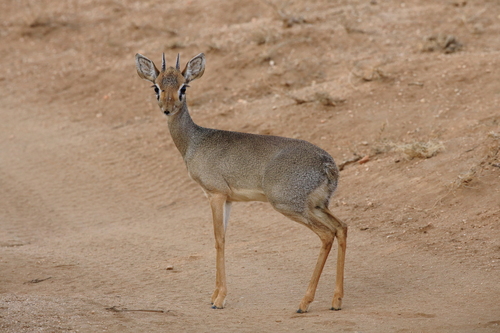
Kirk's dik-dik, the largest of the world's smallest antelopes, stands 14 to 18 inches tall and weighs no more than 7.2 kg (16 lb). Females are typically 1 to 2 pounds heavier than males. These small antelopes are dainty, with a pointed, mobile snout, large eyes and ears, prominent preorbital glands, thin pipestem legs, significantly larger hare-like hind limbs compared to their forelimbs, and a reduced vestigial tail. Coat color varies by habitat, ranging from grey to gray-brown, with tan on the flanks and limbs, an erectile head crest, and whitish markings on eye rings, ear lining, underparts, and rump. Only males grow horns; these are approximately 3 inches (8 cm) long, corrugated, and slanted backward. For Kirk's dik-dik males, horns may be straight or curved backward when viewed from the face profile, and the basal half of the horns has seven to nine annular ridges, which are often hidden by the head crest. Kirk's dik-dik are sexually dimorphic: females are larger, lack horns, while males have a more developed muzzle, a longer crest, and are generally lighter in color. Though very similar in appearance to Günther's dik-dik, Kirk's dik-dik can be told apart by longer nasals and premaxillae, and a shorter proboscis, which gives Kirk's dik-dik a more wedge-shaped head profile than Günther's dik-dik. Kirk's dik-dik are endemic to savanna areas of eastern and southwestern Africa. They occur primarily in the Somali and Southwest arid biotic zones, and sometimes extend into the Southern savanna biotic zone. Their distribution is discontinuous, so they usually live in dispersed patches to meet their unique habitat requirements. In Namibia, Kirk's dik-dik live in isolated areas along the Fish River. They do not reside within the Namib desert, but may cross desert thickets alongside water sources. They prefer habitats with good cover that do not have tall vegetation. Ideal habitats provide a variety of browse, extensive shade, and an open understory at the dik-diks' eye level, as noted by Tinley in 1969. When grass grows too tall and blocks their view, they move to new ranges. Typical Kirk's dik-dik habitats are thicket mosaics that have well-developed shrub layers and very little short grass cover. Dik-diks live in pairs on territories that range from 2 to 86 acres in size, with territory size dependent on cover and available resources. If no adverse events occur, a Kirk's dik-dik pair will stay in the same territory for their entire lives. Males are the primary defenders of territories, as females cannot maintain territories on their own, per Kingdon 1982. MacDonald noted in 1985 that territorial conflicts over high-quality habitat are not common. When conflicts do happen, males charge each other, stopping just before they make physical contact, then repeat the charging process from a longer distance. The encounter ends when one male surrenders; after this outcome, both males scratch at the ground, urinate, and defecate. Like other dwarf antelopes, Kirk's dik-diks live in monogamous pairs within their shared territory. They mark territories with dung and urine in a shared ritual that also helps maintain their pair bond. During the marking ritual, the female excretes first, then the male samples the female's urine stream to check her reproductive status. He paws at the ground, then places his own dung and urine over the female's deposit. Finally, both members of the pair mark nearby twigs with secretions from their preorbital glands. When courting, the male runs up behind the female with his head and neck stretched, and his muzzle pointing forward. Copulation starts with the male standing on his hind legs behind the female, waving his forelegs in the air over her back at an acute angle to his own body. Copulation typically happens three to five times within a 9-hour period. Kirk's dik-diks have a gestation period of 5 to 6 months, and can produce up to two offspring per year. Females reach sexual maturity between 6 and 8 months of age, while males reach sexual maturity between 8 and 9 months. Only one offspring is produced per gestation. Most births take place between November and December, and between April and May, which aligns with regional rainy seasons. Unlike other ruminants, Kirk's dik-dik offspring are born with their fore legs held along the body, rather than extended forward. After birth, offspring stay hidden away from their mother for 2 to 3 weeks, and fawn survival rates are approximately 50%. Once offspring reach a certain age, they begin joining their parents in the pair bonding ritual, and stay with their parents until a new offspring is born. At that point, the parents chase the older offspring out of their territory, and the older offspring goes on to find its own territory and mate.