About Madoqua guentheri Thomas, 1894
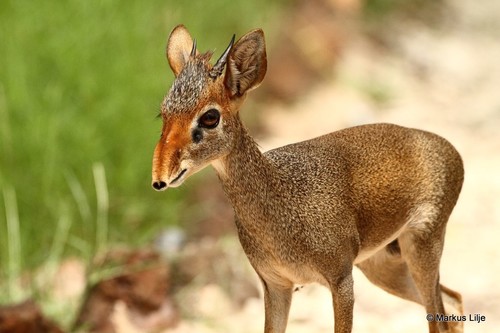
Günther's dik-dik (Madoqua guentheri Thomas, 1894) is one of the smallest ungulates. Fully grown individuals weigh 3–5 kilograms (6.6–11.0 lb). Its coat ranges from yellowish-gray to reddish-brown, with black hooves, small heads on long necks, and large ears that have white insides. The belly, chin, breast, throat, and inner thighs are cream or white, and the tail is short, at approximately 3–5 cm long.
Only male Günther's dik-dik have horns, which average around 9.8 cm in length, though horn length varies between individual males. While horn cores are only found in males, telling the sexes apart from a distance can be difficult. Females are larger than males and have no horns. Four subspecies have been proposed based on differences in body size and pelage features, but these proposed subspecies have not yet been evaluated with genetic analysis.
This species is distributed across the lowlands of Ethiopia, most of northern and eastern Kenya, almost all of Somalia excluding specific coastal regions, limited areas of southeastern Sudan, and northeastern Uganda. It avoids coastal regions entirely. Its typical habitat is low thicket vegetation within thornbush, savanna grassland, and riverine woodland biomes, and it also lives in disturbed and overgrazed areas. Its habitat overlaps with the ranges of other small antelope species, such as Kirk's dik-dik.
Günther's dik-dik is a browser rather than a grazer, and feeds mainly on leaves, flowers, stems, fruits, and seeds of non-grass plants. Because of its small stature, it feeds on plants that grow close to the ground. It is primarily diurnal, with peak activity from dawn to mid-morning, and from mid-afternoon through after dark.
The species is monogamous. Parents and calves do not form long-term family groups; calves are driven away at an early age to survive on their own. Only one calf is born per pregnancy, and the species does not breed seasonally, so it can have late gestation periods. Though it has a limited vocal repertoire of its own, Günther's dik-dik responds to the alarm calls of other species. For example, it reacts by increasing vigilance or fleeing when it hears alarm calls from the white-bellied go-away-bird.