About Maculinea nausithous (Bergstrasser, 1779)
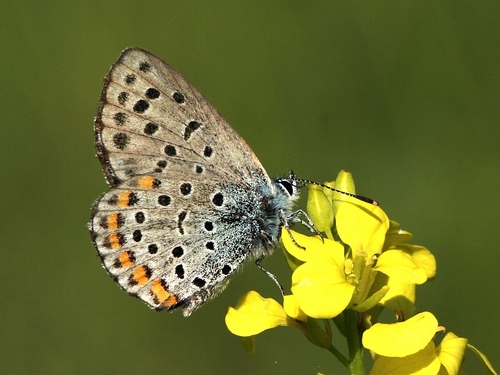
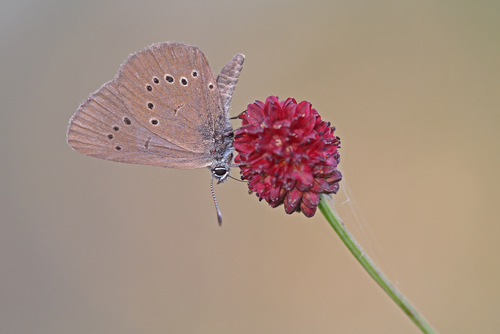
This description of Maculinea nausithous (Bergstrasser, 1779), also referenced as L. arcas Rott. (= erebus Knoch, 83 e) from Seitz, notes that males are similar to Maculinea euphemus, while females have entirely black-brown upper wing surfaces. The species is most easily distinguished by its coffee-brown underside, which bears only one row of ocelli. Several aberrations are recorded: ab. minor Frey consists of small specimens from Switzerland; in ab. inocellata Sohn, the underside ocelli are reduced, while in ab. lycaonius Schultz, the ocelli are entirely absent; in the male aberration ab. lucida Geest, the blue coloration on the upper forewing is lighter and more extensive, and the black discal spots are reduced or no longer present. Maculinea nausithous occurs across Central Europe, ranging from Alsatia to the Ural Mountains, Caucasus, and Armenia, and from Pommerania and the Lower Rhine to Italy. Eggs are laid on Sanguisorba, similar to the eggs of euphemus. Young larvae are pale; older larvae become purple-brown, and are thought to finally turn yellowish-brown. Larvae stay on Sanguisorba flowers when young, then move to feed on the plant's leaves as they grow. Adult butterflies have identical habits to euphemus, and frequently fly alongside this species, during July and August. They are usually even more abundant than euphemus in their typical habitat of damp meadows.