About Maculinea alcon (Denis & Schiffermüller), 1776
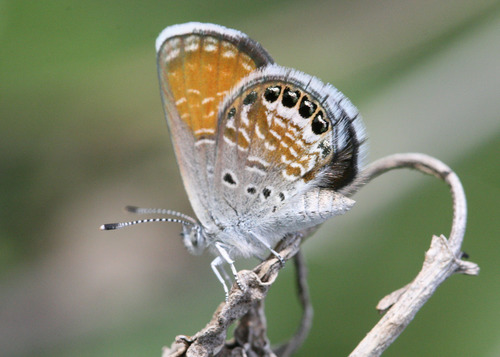
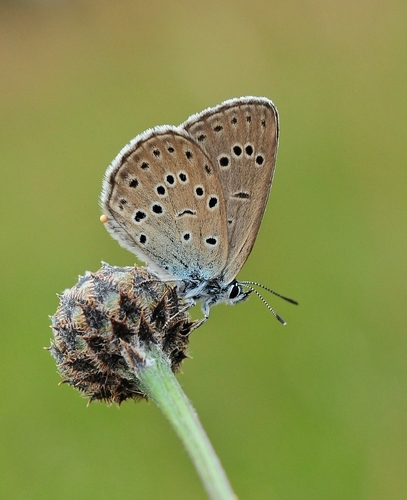
This description of Maculinea alcon, originally published as L. alcon Schiff. by Seitz, notes that the species is large. Males have deep blue upper wings that lack a brilliant gloss, while females are black-brown, with dark blue dusting in the basal wing area. The dark violet-grey underside has numerous ocelli. M. alcon is easily distinguished from related species including coeligena, euphemus, arcas, arion, and arionides by the fact that males have only the discocellular lunule as a black spot on the blue disc of the forewing, with no other black spots present. The species is distributed across Central Europe and North Asia, ranging from the North Sea coast (near Hamburg, Bremen, and Belgium) to the Mediterranean, and from France east to the Altai, Dauria and Tibet. Several named aberrations and forms are recognized: ab. nigra Wheel. has strongly darkened males and entirely black upper wings in females; ab. cecinae Hormuz. has absent or strongly reduced underside ocelli; ab. pallidior Schultz has a grey margin rather than a black one. The subspecies or form marginepunctata Gillm. has a row of black dots running nearly parallel to the wing margin, and was collected by Hafner at Loitsch and other locations in Carniola. The form rebeli Hirschke has more brilliant, more extended blue on the upper wings, with a reduced dark margin; in females only the apical area is black, and this form occurs in Styria. The form monticola Stgr. (83 a) has a narrow black margin matching that of rebeli, but the blue is very deep, dark, and as dull as in the type alcon form, and is found in the Alps of Switzerland and the Caucasus. The egg is white, finely reticulated, and laid on flowers of the food plant Gentiana pneumonanthe. Larvae typically do not break through the upper side of the egg shell, so empty eggs do not have easily noticeable holes. Young larvae are grey; older larvae become reddish brown with a dark dorsal line and a dark head. Adult butterflies occur on damp meadows where Gentiana grows; they are plentiful, sometimes even abundant, in these habitats from the end of May through July, and do not appear before the end of June in more northern areas. Ecologically, adults of the species can be seen flying in mid- to late summer. It lays eggs on marsh gentian (Gentiana pneumonanthe); in the Alps region, eggs are sometimes also found on the related willow gentian (Gentiana asclepiadea). Caterpillars feed on no other plants besides these gentians.