About Macrozamia spiralis (Salisb.) Miq.
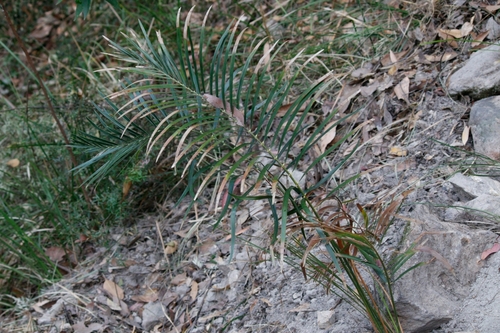
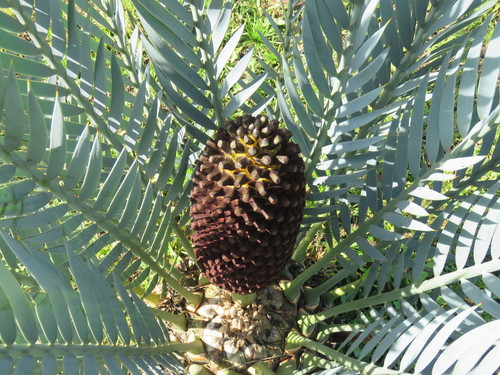
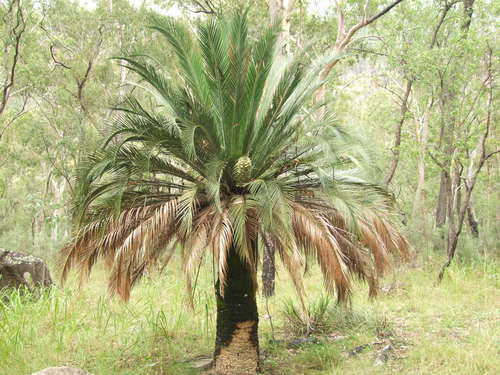
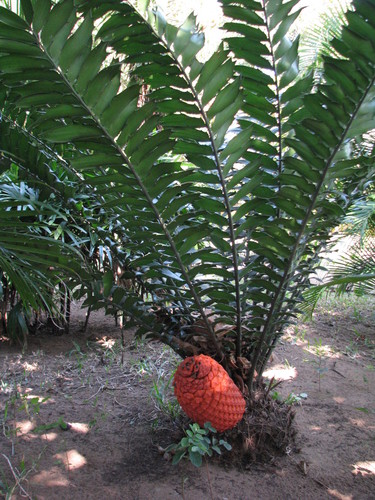
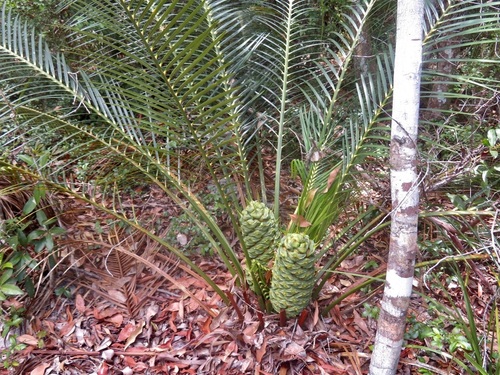
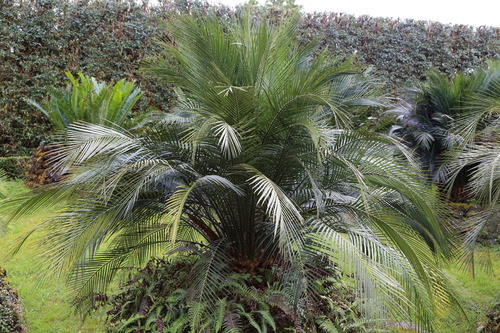
Macrozamia spiralis (Salisb.) Miq. is an acaulescent cycad, with its 8–20 cm (3.2–8 in) diameter stem typically remaining below ground level. Each mature plant produces 2 to 12 leaves, which range from 35 to 100 cm (14–40 in) in length. Each compound frond holds 45–120 simple pinnae; at the leaf's widest point, these pinnae measure 12–20 cm (4.5–8 in) long and 0.5–1 cm (0.2–0.4 in) wide. The leaf rachis is often twisted 180 degrees, and may twist up to 360 degrees, though some leaves have no twisting at all. Male plants grow 1 to 4 fusiform (spindle-shaped) pollen-bearing cones, which measure 15–20 cm (6–8 in) high and 5–6 cm (2–2.4 in) wide. Female plants produce a single oval seed-bearing cone, which measures 12–20 cm (4.5–8 in) high and 6–9 cm (2.4–3.5 in) wide. The fleshy seeds, which range in color from orange to red, are reported to ripen in April and May. This species does not reach reproductive maturity until it is 10 to 20 years old, and individuals are thought to live longer than 60 years. Plants can regrow from the ground after bushfire. Seedlings of Macrozamia spiralis form a tuber and coralloid roots that grow above ground; these roots host cyanobacteria in a symbiotic relationship where the cyanobacteria fix nitrogen for the cycad. A 2010 field study of roots from 74 cycads across multiple genera found that the relationship between cycad and cyanobacterium species is not exclusive; the most common cyanobacteria genera isolated from cycads were Nostoc (which was isolated from M. spiralis) and Calothrix. Macrozamia spiralis occurs in central New South Wales, Australia, ranging from Dunedoo and the Goulburn River valley east across the Blue Mountains into the Sydney Basin. Its range extends south to Waterfall and Wallacia, and north to Maroota and Putty. It is protected and common in several conservation areas, including Werakata National Park, Windsor Downs Nature Reserve, Agnes Banks Nature Reserve, and Castlereagh Nature Reserve. Scattered individuals grow in low-nutrient clay, sandy, or gravelly soils within sclerophyll forest, growing under trees such as narrow-leaved apple (Angophora bakeri) and broad-leaved red ironbark (Eucalyptus fibrosa). This species was classified as endangered in 2003. Macrozamia spiralis can be grown in pots or directly in the ground, but requires good drainage and benefits from additional watering during dry periods. It can be grown under established trees, and can be propagated by seed, though germination takes 12 to 18 months. This plant has been used to produce alcohol, adhesive pastes, and laundry starch.