About Macrozamia riedlei (Gaudich.) C.A.Gardner
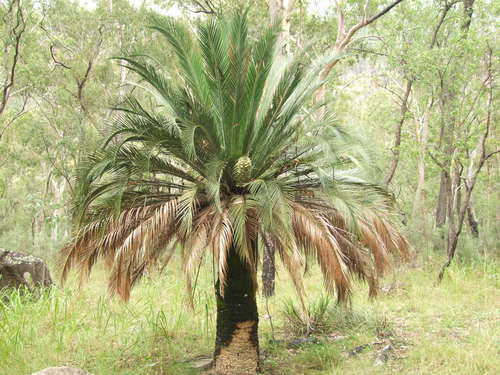
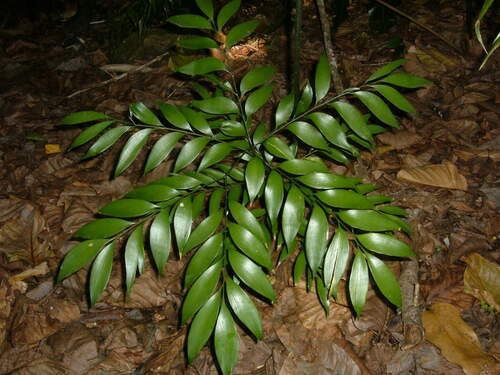
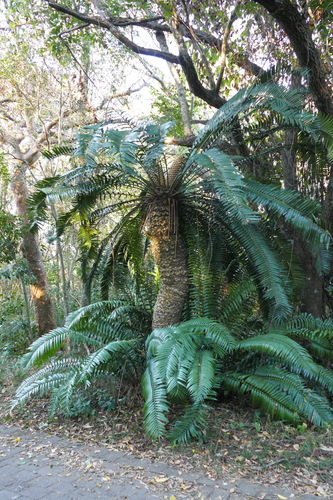
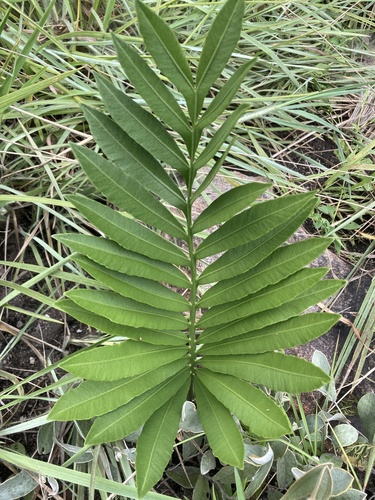
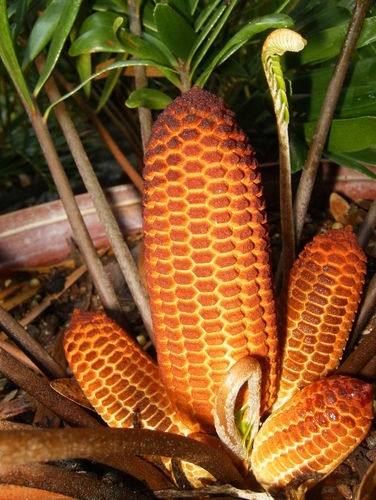
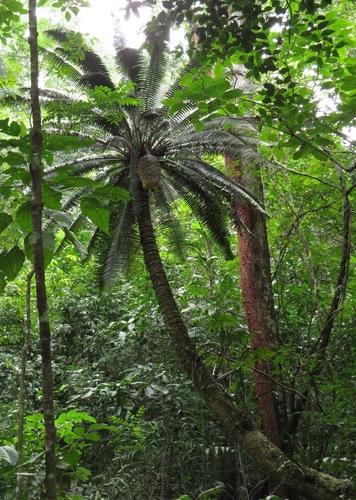
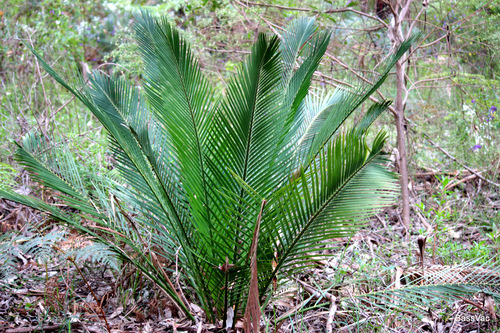
Macrozamia riedlei (Gaudich.) C.A.Gardner is a cycad that usually grows as a trunkless, low-growing plant, though it may occasionally grow as a tree; it reaches an overall height of 0.5 to 3.0 metres (1 ft 8 in – 9 ft 10 in). Its crown produces 12 to 30 glossy mid- to dark-green leaves, each measuring 1.2 to 2.2 metres (3 ft 11 in to 7 ft 3 in) long and bearing 92 to 150 pinnae. The leaves are palm-like, with each frond having a thickened mid-rib, and pinnae arranged evenly on either side. Flowering occurs between September and October. As is typical of the dioecious genus Macrozamia, this species has large reproductive structures, with notable traits in several aspects. Female cones measure 120–250 millimetres (4.7–9.8 in) wide and 250–500 millimetres (9.8–19.7 in) long, and have been recorded weighing up to 14 kilograms (31 lb); the species' eggs and spermatozoids are visible to the naked eye. Cones persist on the plant for many months: smaller pollen-bearing male cones remain green, while larger female cones turn a prominent red. Spores are held in small box-like structures on the underside of leaves until ripe; the equivalent structure on receptive cones is reduced to two seeds that remain attached to the leaf. It can be distinguished from other Western Australian Macrozamia species by its generally trunkless habit, smaller size, fewer glossier flat leaves, and smaller cones. This species is endemic to southern Western Australia, growing on lateritic soils, most often in Jarrah forest. Its range extends from the southwestern coast east to Dwellingup and Albany; it also occurs west of the Esperance Plains and on the Swan Coastal Plain. After proper processing, the 'nuts' of this plant were successfully used as food by Indigenous Australians. However, unprepared seeds caused poisoning when eaten by European explorers, and these are some of the earliest reported cases of poisoning from any Australian native plant. Poisoning from consumption of this cycad's seeds was recorded by multiple European explorers and colonists: Vlamingh in 1697, La Perouse in 1788, Flinders in 1801, and Sir George Grey in 1839. Willem de Vlamingh's 1697 incident, the earliest recorded case of Europeans being poisoned by an Australian plant, was recorded in an unsigned ship's journal entry by an officer who ate the seeds while exploring the Swan River area. Ingestion of unprepared seeds caused vomiting several hours after consumption, described as so severe that those afflicted were close to death. A second-hand published account printed in Amsterdam embellished the incident, describing men incapacitated by involuntary movements. Poisoning of the La Perouse expedition crew was noted by Governor Phillip, who reported it caused the same violent vomiting. Some crew members of Matthew Flinders' circumnavigation expedition also made the same mistake, consuming M. riedlei toxins while anchored at the south coast. In 1829, at the founding of the Swan River Colony, Captain Charles Fremantle ate three 'ground nuts' found at a local campfire, and described their taste as inoffensive, similar to roast potato. He woke the next morning with poisoning symptoms, and recovered later that day after drinking tea as an emetic and sleeping. Fremantle recorded irritably that, even after seeing and being told of the consequences of eating the seeds, many of his men and two officers still ate them, and some suffered severe reactions. George Grey's party's misadventure happened on 13 April 1839, when the group was traveling to Perth after being shipwrecked at Gantheaume Bay, Kalbarri. The party carried very few rations and did not collect adequate food resources during their 300 km journey. They had previously been given and fed a small amount of properly prepared seed, so they later sought and collected fresh unprepared seed. Improperly prepared seed meal left the party temporarily unable to travel. Known to the Noongar people as by-yu and djiriji, this species was an important staple food once processed, with the flesh around the seeds forming a regular part of their diet, a use consistent with how many cycad species are used around the world. The stem also provides starch, which was used by colonial settlers as 'bush flour', a substitute for flour from introduced grains. Evarist (1979) notes that early settlers observed Aboriginal preparation methods, and used trunk pith starch for food after processing: drying, shredding, soaking in water for several hours, filtering, settling, washing several times, drying slowly, and powdering. Early visitors and colonists recorded harvesting fruit from the plant, or finding prepared food at Noongar camps, or receiving it when hungry. In 1832, newcomer Henry Camfield noted that Noongar elder Midgegoroo and other people gathered the nuts on the land he had settled at Burswood, Western Australia. The traditional seed preparation method is called mordak by Noongar people; a nearly intact example of this preparation excavated from a cave in Cape Le Grand National Park has been dated to 13,000 years old. Ripe unprepared seed of M. riedlei is called pauyin, and it is harvested at the end of March, after the Australian summer. Settlers gave the toxic effects of the plant the informal names 'wobbles' and 'rickets', which describe the condition that develops when cattle graze on the plant. In this introduced mammal, ingestion of the leaves causes the condition, which begins with paralysis of the rear quarters and eventually results in death. This led settlers to try to eradicate the species in grazing areas. The toxins found in the cone and other parts of the plant are macrozamin and cycasin, which are produced in coralloid roots by nitrogen-fixing cyanobacteria. The coralloid root system forms a symbiosis between the cycad's roots and cyanobacteria from the genera Nostoc and Calothrix. In M. riedlei, nitrogen (N₂) capture is most active during wet seasons, and the plant's total nitrogen content doubles within 8–11 years. Studies of response to recent burning found that the weight ratio of coralloid roots to the plant bole increases, and nitrogen concentration in the roots is higher. This suggests nitrogen fixation supports the rapid leaf regrowth that occurs after fire events. Avian and mammalian species are attracted to the species' reproductive cone structures, and insects are involved in pollinating the female plant. Bird species that eat the fleshy part of the seed cone include the nominal subspecies of western rosella (moyadong, Platycercus icterotis icterotis); other birds recorded eating the seeds include emu, common bronzewing pigeon (Phaps chalcoptera), white-tailed black cockatoo, silvereye, grey butcherbird, and Australian raven (wodang, Corvus coronoides). Mammal species recorded associated with the plant are western grey kangaroo (Macropus fuliginosus), western brush wallaby (Macropus irma), quokka (Setonix brachyurus), common brushtail possum (Trichosurus vulpecula), and western quoll (Dasyurus geoffroii). The Catholic Church of Western Australia uses this species' fronds as a substitute for palm tree fronds on Palm Sunday. The ancient form of the plant inspired poetry from poet Judith Wright. Macrozamia riedlei has horticultural potential as a large container plant or garden specimen. It requires well-drained soil and is sensitive to fungal attack. Large specimens can be transplanted. Seeds germinate within 12 to 18 months. Most species in the genus Macrozamia are cultivated, and M. riedlei is one of the best-known cultivated species. Wrigley & Fagg (2003) note it is well suited to rockeries and containers. In cultivation, the trunk may reach two metres tall; the dark green, palm-like pinnate fronds reach or exceed two metres as specimens age. Garden-grown plants usually reach a similar size to wild plants, between one and two metres tall, and are slow-growing in their native habitat; container-grown specimens tend to stay smaller. They respond well to general purpose fertiliser, and grow best in full sun or partial shade. It is recommended as an indoor plant, since it tolerates low light and cool temperatures, is slow-growing, and can remain in a container indefinitely. The distribution of this zamia in southwest Western Australia correlates with sites of long-term human habitation, near lakes, springs, and freshwater points at granitic outcrops of kwongan. However, the seed dispersal activities of other consumers (birds and mammals) complicates the hypothesis that inadvertent or intentional human cultivation is the primary factor shaping the species' current distribution. Animal species involved in seed dispersal include birds like the emu, and the common brushtail possum (Trichosurus vulpecula, known locally as quumarl), a mammal. Fruiting cones fully ripen and break apart during bunuru, the local season between February and March, when the seeds are ready to harvest.