About Macroramphosus scolopax (Linnaeus, 1758)
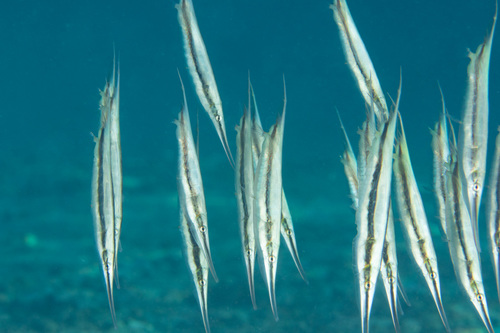
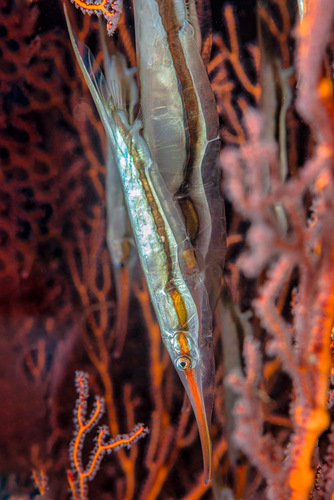
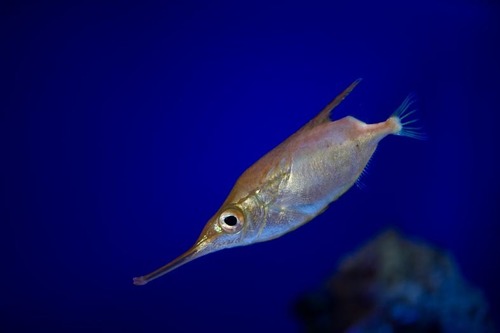
Longspine snipefish, Macroramphosus scolopax, have a reddish pink back and silvery belly. They feature large eyes, long snouts, and a slender spine that protrudes from their dorsal side. Total body length of this species ranges from 4.8 to 16.0 cm (1.9 to 6.3 in). For mature individuals, males range from 9.1 cm to 13.8 cm with a mean length of 11.74 cm, while females are slightly larger, ranging from 9.7 cm to 16.0 cm with a mean of 13.12±1.743 cm. Males also have a slightly shorter postocular head length than females. A key prominent trait is the second spine in the first dorsal fin, which measures between 21.92 mm and 36.47 mm. This species shows wide morphological variation. Research by Barbara Zorica and Nedo Vrgoč identified three distinct morphological types: the scolopax type, the gracilis type, and the intermediate type. The scolopax type has a deep body, a long serrated dorsal spine, and brick reddish color. In contrast, the gracilis type has an elongated body, a shorter non-serrated dorsal spine, and bluish-grey color. A full series of intermediate forms exist between these two extreme morphologies. The study found no observable external sexual dimorphism, though researchers could identify females by the presence of a dark genital papilla and a swollen abdomen. Males are known to develop temporary color changes during courtship, growing darker ventral areas and red patterns that fade quickly if the fish are disturbed or fed. In a separate study, Thomas A. Clarke proposed that the two primary morphotypes correspond to different feeding groups: the scolopax type is a benthic feeder, while the gracilis type is planktivorous. Planktivorous individuals have relatively longer snouts, more slender bodies, shorter second dorsal spines, and smaller eyes. Benthic feeding individuals have shorter snouts, deeper bodies, longer dorsal spines, and larger eyes. Even though the two studies used different naming systems, the gracilis type matches Clarke’s planktivorous type, and the scolopax type matches Clarke’s benthic feeding type, which is the deeper-bodied form with longer spines. Further research conducted at the Great Meteor Seamount supports classifying the two feeding and morphological types as separate sympatric species within the Macroramphosus scolopax complex. This study also rejected the hypothesis that the gracilis type is simply the juvenile stage of the scolopax type, since all measured gracilis specimens were larger than scolopax specimens in this sample. Another study of samples collected in Portuguese waters also suggests that Macroramphosus scolopax may contain two distinct species, though the study’s author notes that additional research is needed to confirm whether reproductive isolation exists between the morphotypes and to validate this reclassification. This fish is found worldwide in tropical to subtropical waters across the Atlantic, Indian, and western Pacific Oceans. It has also been recorded in the eastern Pacific near Santa Catalina Island, California. It occurs most commonly at temperate latitudes between 20–40°N, but can also be found in the southern hemisphere as far south as 43°S. It typically inhabits depths from 25 to 600 m (82 to 1,969 ft), and shows a clear preference for depths over 100 meters, especially favoring deeper areas of the continental shelf and continental slope. Males change color before courtship to attract females: their brownish ventral area and the base of the dorsal spine darken, while the posterior part of the body turns brick red. this dark coloration extends forward along the back and sides. The entire color pattern can fade within seconds if the fish are startled. During the courtship period, males show aggressive behavior toward each other, and these fights are tied to gaining access to mating opportunities. Longspine snipefish normally maintain a head-down posture, but two competing males will instead swim parallel toward each other, abandoning the typical head-down position. This parallel swimming acts as a signaling behavior before actual competition begins. A common aggressive behavior between courting males is striking an opponent with an erect dorsal spine: an attacking male swims rapidly toward the rival, turns its back toward the other fish, and strikes with the raised dorsal spine. After the strike, the attacking male swims away to gain distance to improve its aim and speed for the next charge. The attacked male usually stays stationary in a head-down position and may roll its body to reduce the area exposed to attack. Courtship takes place in the late afternoon, starting when the fish are near the seabed. Courting males follow and swim parallel to the female near the bottom while holding a head-down position. When the male moves close enough, the female erects her dorsal spine. The male follows the female’s movements, frequently switching position from one side of the female to the other. Next, the male slowly bends his caudal peduncle toward the female at a 90-degree angle, and the female moves her abdomen toward the male. The two fish join by their caudal peduncles, and then swim together upward toward the water surface. During this ascent, the female’s genital papilla extends and makes repeated contact with the male’s genital region. Egg release and fertilization both occur during this upward movement. Once the fish reach the surface, they separate and return to the bottom. The author of this observational study suggested that the duration of the ascent and its endpoint at the surface may be influenced by experimental conditions, specifically the limited depth of the tank used for observation.