About Macropus rufus (Desmarest, 1822)
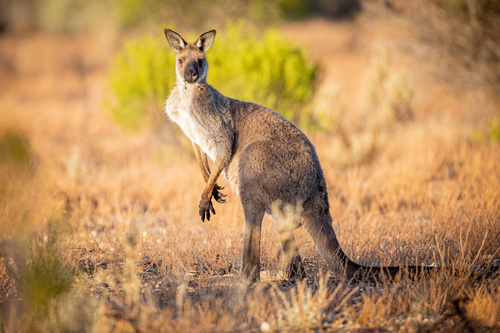
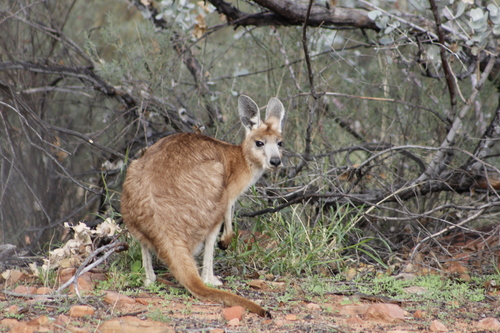
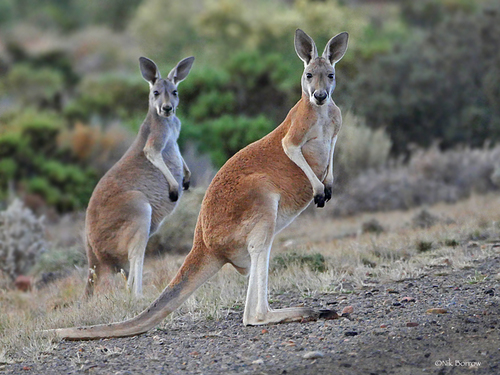
Macropus rufus (Desmarest, 1822), commonly known as the red kangaroo, is a very large kangaroo species with long, pointed ears and a square-shaped muzzle. This species is sexually dimorphic: males have short red-brown fur that fades to pale buff on the underside and limbs, while females are smaller than males, with blue-grey fur tinged brown and pale grey fur on the underside; females living in arid zones have colouring more similar to males. It has two forelimbs with small claws, two muscular hind limbs built for jumping, and a strong tail that is often used to form a tripod when the animal stands upright. Mature males can grow to a head-and-body length of 1.3–1.6 m (4 ft 3 in – 5 ft 3 in), with a tail that adds an additional 1.2 m (3 ft 11 in) to total length; Australians call adult males "Big Reds". Females are considerably smaller, with a head-and-body length of 85–105 cm (33–41 in) and a tail length of 65–85 cm (26–33 in). Females weigh 18 to 40 kg (40 to 88 lb), while males typically weigh about twice as much, at 55 to 90 kg (121 to 198 lb). The average red kangaroo stands approximately 1.5 m (4 ft 11 in) tall to the top of the head in an upright posture. Large mature males can stand taller than 1.8 metres (5 ft 11 in); the largest confirmed individual reached around 2.1 m (6 ft 11 in) tall and weighed 91 kg (201 lb). The red kangaroo maintains a stable internal body temperature of around 36 °C (97 °F) through a combination of physical, physiological, and behavioural adaptations. These include an insulating fur layer, reduced activity and shade-seeking during high temperatures, panting, sweating, and licking its forelimbs. It has an exceptional ability to survive extreme temperatures, adjusting panting and sweating rates to cool its body. To conserve energy during harsh conditions, red kangaroos can enter a state of torpor. They also have a high tolerance for plants with high salt content, and can survive long periods without water by reabsorbing water from urine in the kidneys to minimize water loss. They can go for extended periods without drinking, meeting all their moisture needs from the vegetation they consume. Due to the position of their eyes, red kangaroos have a total visual range of approximately 300°, with a measured maximum of 324° and around 25° of overlap between the two eyes. The red kangaroo lives across western and central Australia, occupying scrubland, grassland, and desert habitats. It typically inhabits open areas that provide some trees for shade, and its water-conserving adaptations allow it to survive in arid environments. Its kidneys efficiently concentrate urine, especially during the summer months. Red kangaroos feed primarily on green vegetation, particularly fresh grasses, forbs, and other dicotyledonous flowering plants, and can find enough green food even when most vegetation appears brown and dry. One study of red kangaroos in Central Australia found that green grass makes up 75–95% of their diet, with the grass Eragrostis setifolia accounting for 54% of total consumption; this species remains green through the dry season. In western New South Wales, another study found red kangaroos fed primarily on Eragrostis setifolia and Enneapogon avenaceus, with Eragrostis setifolia making up 21–69% of their diet. During dry periods, kangaroos search for green plants by remaining on open grassland and near watercourses. While grasses and forbs are preferred, red kangaroos will also eat certain species of chenopods, such as Bassia diacantha and Maireana pyramidata, and will even browse on shrubs when their preferred food is scarce. However, they avoid some perennial chenopods, such as the round-leaf chenopod Kochia, even when this plant is abundant. In areas with abundant forage, large numbers of red kangaroos may congregate in groups of up to 1,500 individuals. Red kangaroos are mostly crepuscular and nocturnal, resting in shade during the day, though they sometimes move around during daylight hours. Instead of using rocky outcrops or caves, they rely on small saltbushes or mulga bushes for shelter during extreme heat. Grazing makes up most of their daily activity. Like most kangaroo species, they are mostly sedentary and stay within a relatively well-defined home range, but will travel long distances in response to major environmental changes. In New South Wales, red kangaroos have weekly home ranges of 258–560 ha (640–1,380 acres), with adult males occupying larger ranges. When forage is poor and rainfall is patchy, kangaroos will travel 25–30 km (16–19 mi) to reach more favourable feeding grounds. A study of red kangaroos in central Australia found most individuals stay close to remaining vegetation, but disperse to find fresh plants after rain. The red kangaroo’s large size means it faces almost no significant non-human predation as an adult, and it can use its strong legs and clawed feet to deliver defensive kicks and blows to attackers. Dingoes and birds of prey may prey on young joeys, and a pack of dingoes or a pair of wedge-tailed eagles can occasionally kill adult red kangaroos. Saltwater crocodiles may also prey on kangaroos. Red kangaroos are skilled swimmers, and will often flee into waterways when threatened by a terrestrial predator. If pursued into the water, a kangaroo may use its forepaws to hold a predator underwater to drown it. Red kangaroos breed year-round. Females have the unusual ability to delay the birth of their offspring until their previous joey has left the pouch, an adaptation called embryonic diapause. Copulation can last 25 minutes. The species has the typical reproductive system of a kangaroo: a neonate is born after only 33 days of gestation, and usually only one young is born per pregnancy. Newborns are blind, hairless, only a few centimetres long, and have underdeveloped hind legs that are little more than stumps. The newborn uses its more developed forelegs to climb through its mother’s abdominal fur into her pouch, a journey that takes three to five minutes. Once inside the pouch, the newborn attaches to one of two teats and begins feeding. Almost immediately after birth, the mother’s sexual cycle restarts; another egg moves into the uterus and she becomes sexually receptive. If she mates and a second egg is fertilized, its development is temporarily halted. Meanwhile, the neonate in the pouch grows rapidly. After approximately 190 days, the joey is large and developed enough to fully emerge from the pouch, after first sticking its head out for several weeks until it feels safe enough to leave completely. From that point, the joey spends increasing amounts of time outside the pouch, and finally leaves the pouch for good at around 235 days old. Even after permanently leaving the pouch, the young joey continues to suckle until it reaches 12 months of age. A female red kangaroo may first reproduce as early as 18 months of age, or as late as five years during drought, but normally begins breeding at two and a half years old. Female red kangaroos are usually permanently pregnant except on the day they give birth, and can pause embryo development until the previous joey is ready to leave the pouch. This embryonic diapause occurs during drought and in areas with limited food. The composition of the milk a mother produces changes to meet the changing needs of her developing joey. Female red kangaroos can simultaneously support up to three generations of offspring: a young-at-foot suckling from an elongated teat, a younger joey in the pouch attached to a second teat, and a dormant blastula-stage embryo arrested in development in the uterus. Red kangaroos have been observed engaging in alloparental care, a behaviour where a female will adopt another female’s joey. Like all Australian wildlife, the red kangaroo is protected by Australian legislation, but its population is so large that regulated harvest of its hide and meat is permitted. Hunting permits and commercial harvesting are controlled under nationally approved management plans that aim to maintain stable red kangaroo populations and manage harvest as a renewable resource. In 2023, over half a million red kangaroos were harvested across Australia. Commercial kangaroo harvesting is controversial, largely due to the species’ popularity. In 2000, 1,173,242 red kangaroos were killed. In 2009, the Australian government set a commercial harvest limit of 1,611,216 red kangaroos. The commercial kangaroo industry generates approximately A$270 million in revenue each year and employs over 4,000 people. Red kangaroo meat is sold for human consumption and used in pet food, and is very lean with only around 2% fat. Red kangaroo skins are used to make leather.