About Macropus eugenii (Desmarest, 1817)
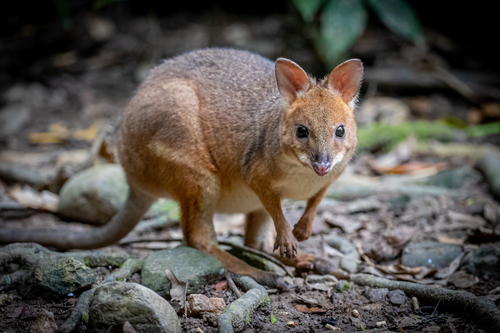
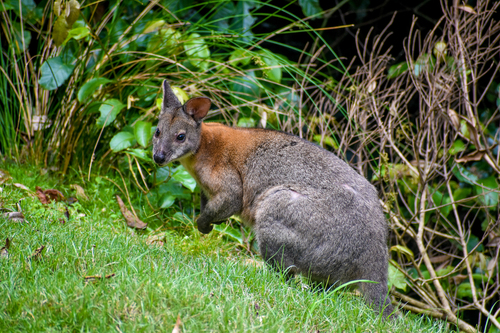
The tammar wallaby (Macropus eugenii) is one of the smallest wallaby species. It has a proportionally small head, large ears, and an elongated tail with a thick base. Its upperparts are dark greyish, with a paler underside and rufous-colored sides and limbs. This species shows strong sexual dimorphism: males reach an average weight of 9.1 kg (20 lb), while females average 6.9 kg (15 lb). Males measure 59 to 68 cm (23–27 in) in body length, versus 52 to 63 cm (20–25 in) for females, and both sexes stand 45 cm (18 in) tall. Male tails are 34 to 45 cm (13–18 in) long, and female tails are 33 to 44 cm (13–17 in) long.
In terms of ecology and life history, tammar wallabies stay near scrub for shade during the day, and move out to open grassland at nightfall. In winter, their home ranges are around 16 hectares (40 acres), but in dry summers they travel farther to find high-quality food, requiring around 42 hectares (100 acres) of space. The home ranges of tammar wallabies overlap with those of other members of their species. Like all macropods, tammar wallabies are herbivorous; they both graze and browse, though browsing is less efficient because they commonly drop leaves while chewing. They handle large leaves using their fingers. Known plant foods include heart-leaved poison (Gastrolobium bilobum), small-flowered wallaby grass (Austrodanthonia setacea), and marri (Corymbia calophylla). Tammar wallabies can survive on islands with no fresh water by subsisting on seawater.
Tammar wallabies form groups, which reduces the chance that any individual will be preyed upon. As group size increases, tammar wallabies spend more time feeding, grooming, and interacting, and less time being vigilant and moving. They are also more likely to rest on their sides instead of holding an alert posture with their head raised. Known predators include dingoes, feral cats, red foxes, and wedge-tailed eagles; the now-extinct thylacine may also have preyed on them. Tammar wallabies respond more strongly to the sight of predators than the sound, and can use their sharp sense of smell to detect potential threats. When a predator is spotted, a tammar wallaby will alert other group members by thumping its foot. When lost, young tammar wallabies produce a distress call, and adult females may respond with a similar call.
The tammar wallaby is a model organism used to study marsupial biology and mammal biology more broadly. It has been used in research across reproductive biology, immunology, metabolism, neurobiology, and many other fields. Its seasonal and lactational control of reproduction makes its reproductive biology particularly well-suited for study. A 2017 study by Saunders and colleagues suggested the bipedal tammar wallaby is a better model for human spinal cord injury research than quadrupedal rodents. Tammar wallabies are easy to keep in captivity because they are non-aggressive, tolerate surgeries well, and reproduce easily, with just one male needed for every five females. Individuals used for scientific research are typically housed in outdoor pens with adequate water and shelter, rather than in indoor laboratory spaces.
Marsupial genomes are of high interest to scientists working in comparative genomics, and study of the tammar wallaby has yielded extensive information about the genetics of marsupials and mammals overall. Marsupials have an evolutionarily convenient level of divergence from humans: mice are genetically too similar and have not evolved many distinct functions, while birds are genetically too distant. Key immune genes from the tammar wallaby were the focus of highlighted research in 2009. In 2011, the tammar wallaby became the second marsupial, after the grey short-tailed opossum, to have its full genome sequenced. Researchers found innovation in reproductive and lactational genes, rapid evolution of germ cell genes, and incomplete, locus-specific X inactivation. They also discovered new HOX genes that control gene expression, as well as new microRNAs. Genes for milk production were found to be novel, while gonad genes were found to be more conserved. Before full genome sequencing of marsupials, the identification and characterization of important immunological components was limited for most marsupial species. Current sequencing and annotation of whole marsupial genomes have improved understanding of marsupial immune systems by simplifying the characterization of immune molecules, and have supported progress in biomedical research. A 2017 molecular study of the tammar wallaby and mink found that EGF, FOXO, and CDKN1A may be involved in controlling mammalian embryonic diapause. IL-10 and IL-10Δ3 are conserved in the tammar wallaby, indicating its immune system responds to pathogens similarly to other eutherian mammals via these same immune components.
A protein compound called AGG01 found in tammar wallaby milk has been identified as a potential new effective antibiotic. In laboratory testing, AGG01 has proven to be far more powerful than penicillin. It kills many types of pathogenic bacteria, including both Gram-positive and Gram-negative strains, and at least one fungus. Subsequent genome analysis has led to the discovery of several cathelicidin peptides, which could also be used as antibiotics. The foregut of the tammar wallaby hosts bacteria from the phyla Bacillota, Bacteroidota, and Pseudomonadota. Two new bacterial species have been discovered: WG–1 of Pseudomonadota and TWA4 of Bacillota. These bacteria produce less methane than other comparable bacteria and do not require carbon dioxide to survive. This discovery has important environmental implications, as the information could be used to reduce greenhouse gas carbon production in livestock.