About Macropus dorsalis (Gray, 1837)
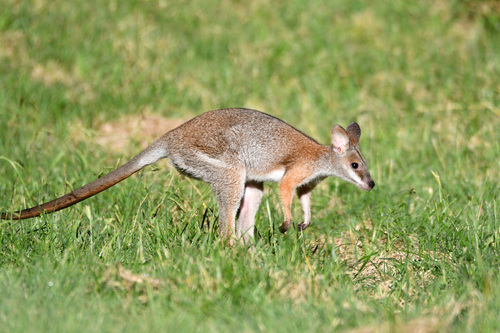
The black-striped wallaby, scientifically named Macropus dorsalis (Gray, 1837) and also referred to as Notamacropus dorsalis, the scrub wallaby, or the eastern brush wallaby, is a medium-sized wallaby that occurs in Australia. Its range extends from Townsville in Queensland to Narrabri in New South Wales, and in New South Wales, it is only found west of the Great Dividing Range. The species' population is declining across this range, but the species as a whole is not currently classified as threatened. However, the separate population located in New South Wales is classified as endangered. The black-striped wallaby looks similar to the mainland Australian subspecies of the red-necked wallaby, but can be distinguished by a black stripe running down its back, a white stripe over the hip, and more extensive red colouration that extends down the arms and further along the abdomen. This wallaby is shy, predominantly nocturnal, and feeds by grazing. It is not well studied or widely known, because it prefers to live in thick scrub where it can easily remain hidden. Its preferred food appears to be the leaves and seedheads of monocotyledonous plants.