About Macroptilium atropurpureum (DC.) Urb.
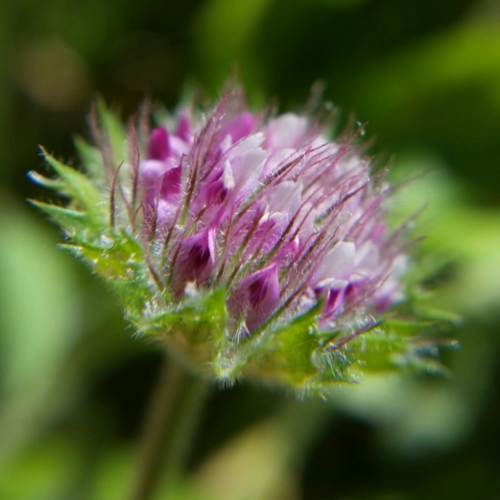
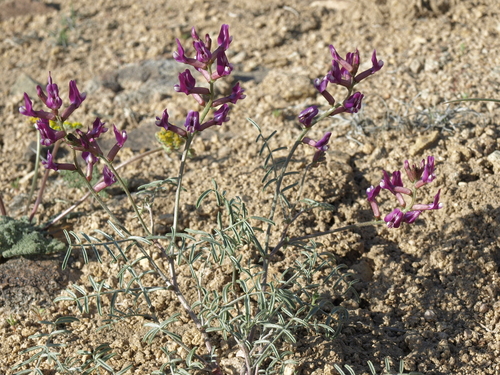
Macroptilium atropurpureum (DC.) Urb. is a tropical herbaceous dicot in the Fabaceae family. It rapidly grows dense, hairy, dark green vines around 5 mm in diameter, reaching a mature height of approximately 120 cm. These vines bear bright green trifoliolate leaves, which measure roughly 2–7 cm long and have soft smooth hairs on their undersides. The plant produces dark reddish purple flowers. Its seeds are small brown peas with a distinct white spot, contained in pods that hang in clusters of 5 to 10 along the vines. Under favorable weather and soil conditions, stem nodes near the soil can root, allowing the species to propagate vegetatively. M. atropurpureum forms a deep, swollen taproot that can grow up to 2 cm in diameter. This species has many common names: it is widely known as Siratro or Aztec, where these are modified cultivars bred for improved nematode resistance and reduced rust sensitivity respectively. Other common names include purple bush-bean in English, Purpurbohne in German, and conchito in Spanish. It is a short-lived species that grows at high density, producing between 1200 and 1700 plants per acre when growing freely in its growing season. M. atropurpureum is native to Central America, South America, and the Caribbean Islands. It also grows naturally in parts of southern North America, including Mexico and the US states of Arizona, Texas, Florida, and Hawaii, as well as coastal regions of Queensland and New South Wales, Australia, and scattered areas across Africa. This plant has historically been used as pasture for domesticated livestock, and it was the first tropical pasture species improved through selective breeding. Breeding work on the native species was conducted in Australia during the 1960s to develop resistance to root nematodes, resulting in the modified cultivar 'Siratro'. Siratro was found to have high sensitivity to rust, so the cultivar 'Aztec' was developed in 1995 to address this issue. On indigenous farms across North and South America where the species occurs, M. atropurpureum has often been used as a dry-season ground cover, taking advantage of the legume’s nitrogen-fixing ability. This use prevents soil erosion and acts as an organic fertilizer. The species is considered invasive in New Caledonia, where it was first introduced in 1963.