About Macropodus opercularis (Linnaeus, 1758)
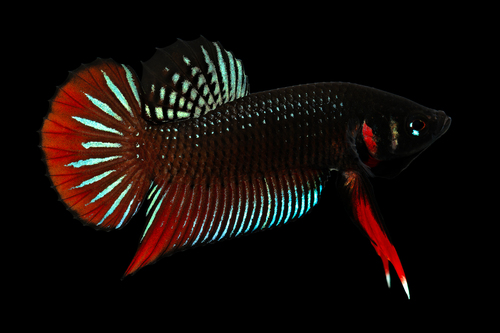
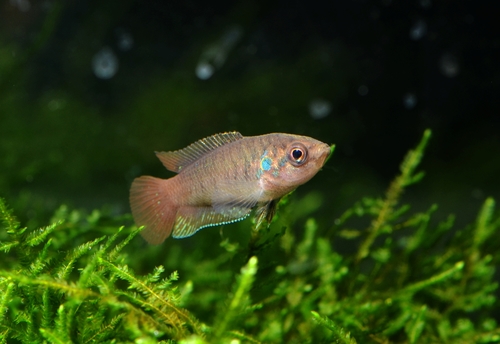
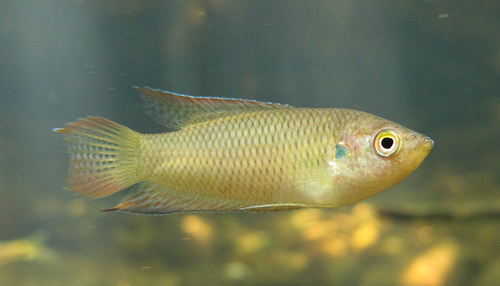
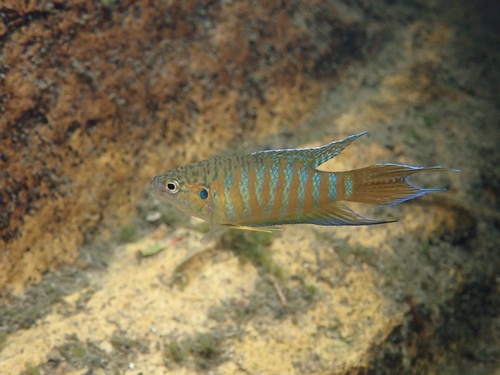
Macropodus opercularis, commonly known as the fork-tailed paradisefish, paradise fish, or paradise gourami, is a species of gourami that lives in most types of fresh water across East Asia, ranging from China to northern Vietnam. This species can reach a standard length of 6.7 cm (2 5⁄8 inches), though most individuals only grow to about 5.5 cm (2 3⁄16 inches). It was the second Chinese ornamental fish introduced to the West, following the goldfish, and was the first freshwater tropical fish successfully bred in captivity in Europe. French aquarium fish importer Pierre Carbonnier imported this species to Paris, France in 1869. The paradise fish is one of the more aggressive members of its family: it is more aggressive than the three spot gourami, but less pugnacious than the less commonly kept combtail in the wild. Paradise fish tolerate a very wide range of water conditions, and can survive in both cool and warm waters. In the wild, they are most often found in shallow water with dense vegetation, such as marshes or rice fields. They can also be kept in outdoor ponds, or even the simplest type of unheated aquaria. They will accept almost any food, but they require a reasonably high-protein diet rather than a vegetable-based one. Their diet also includes mosquito larvae, black worms, brine shrimp, and small flies. Like most bettas and other gouramis, spawning in this species involves the male building a bubble nest — a floating mat of saliva-coated air bubbles that often incorporates plant matter — and attracting a female to the nest. If the female accepts the male's advances, the pair will embrace in open water, releasing both eggs and sperm into the water. After each embrace, the male collects the fertilized eggs and spits them up into the bubble nest. After spawning is complete, the male may violently attack his mate or any other fish that approaches the fertilized eggs or newly hatched fry, both of which are common food sources in the natural habitat. Breeders usually move the female to a separate tank to improve the survival chances of both the female and the hatched fry. Once the fry begin to swim freely, the male's protective behavior fades, so breeders remove the male to protect the fry. The young fry are raised on infusoria or newly hatched brine shrimp. An albino morph of Macropodus opcularis is available in the aquarium trade. Many aquarists note that this albino form is less aggressive than the wild type, but it is also less hardy, and struggles more with low temperatures.