About Macropodia rostrata (Linnaeus, 1761)
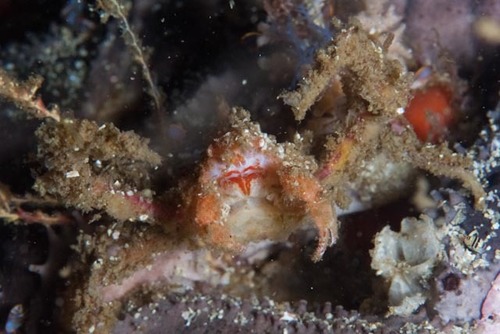
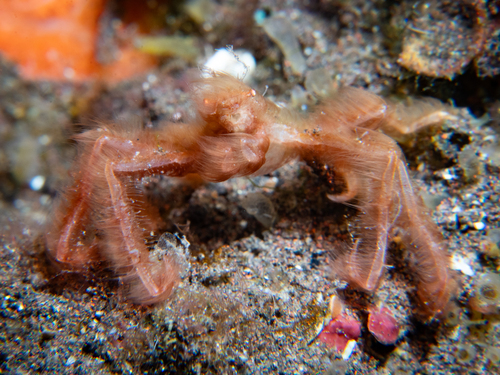
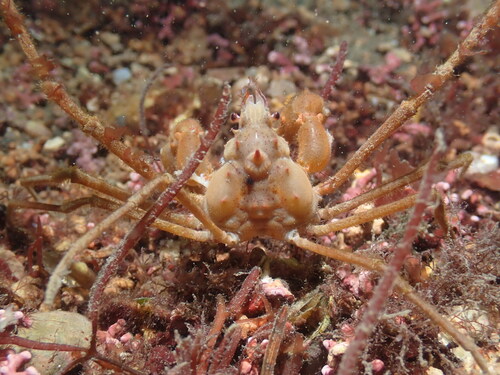
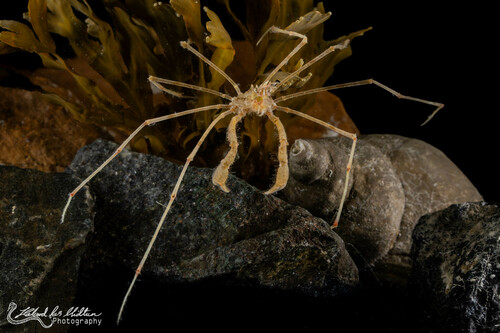
Macropodia rostrata (Linnaeus, 1761) has a hairy, fuzzy appearance because it attaches algae to its own body for camouflage. The carapace and pereiopods of this species range in colour from greyish to yellowish or reddish-brown, and some individuals have white markings. The carapace reaches a maximum length of 16 (28) mm, and its anterior section narrows toward the front, giving the carapace a pear shape. Carapace length is measured along the median line, from the anterior margin to the posterior margin. The surface of the carapace has numerous hook-setae. When viewed from above, the eye-stalks are completely visible. Macropodia rostrata uses its eyes alongside other sensory organs to locate and catch prey. As a decorator spider crab, it is omnivorous, and most individuals act as underwater scavengers, consuming a wide range of food from algae to mollusks and small fish. In addition to providing camouflage, the algae covering this crab’s limbs also acts as an emergency food source. Macropodia rostrata is distributed along the coasts of Europe and western Africa, ranging from 65° N in Norway to South Africa. Its range includes the Mediterranean Sea and parts of the Black Sea. Unlike giant Japanese spider crabs, Macropodia rostrata is not found on the deep ocean floor. It mainly lives at depths between 0 and 50 metres (0 to 164 ft), though it can occasionally be found as deep as 150 m (490 ft). It is most commonly found on muddy sand and on kelp. Because it moves slowly, Macropodia rostrata is easily preyed upon. Its main defense against predators such as gulls and shorebirds is to wave its pincers over its head when startled. While large fish and sharks do sometimes prey on these crabs, their hard shells often deter these predators. Genetics cannot currently explain what determines the minimum and maximum post-puberty sizes of Macropodia rostrata, but scientists hypothesize this variation stems from differing ecological histories. It was originally expected that male Macropodia rostrata would show changes to their genital papillae and first intromittent organs that align with the molt of puberty, but observations found no correlation between carapace length and the size of genital papillae. For male Macropodia rostrata, the largest pre-puberty carapace length recorded is 18mm, with a mean pre-puberty carapace length of 16.4mm. Males can reach a maximum post-puberty carapace length of 23mm. Females of the species are generally smaller, reaching a maximum post-puberty carapace length of 20mm. The largest pre-puberty carapace length a female can reach is approximately 14 mm, and the average post-puberty carapace length for females is 14.4mm. Several distinct physiological changes happen as Macropodia rostrata reaches sexual maturity. In males, sexual maturity is marked by the swelling and colour change of the sperm ducts. This change occurs because sperm production creates spermatophores that hold the sperm, which turns the ducts white. In females, sexual maturity is indicated by changes in the shape and diameter of the ovaries. For both males and females, the moult of puberty is required for reproduction: females do not ovulate before this moult, and males do not produce sperm before it. After completing the moult of puberty, Macropodia rostrata can copulate at any time. Following copulation, females store sperm in spermathecae, and can use this stored sperm for multiple ovulations. Macropodia rostrata produces eggs that are approximately 0.6mm in size, and the number of eggs a crab produces is influenced by several factors. Macropodia rostrata is a continuous breeder, and does not have a specific mating season.