About Macropis nuda (Provancher, 1882)
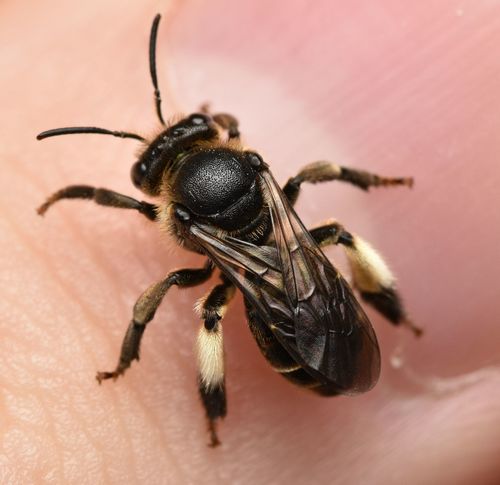
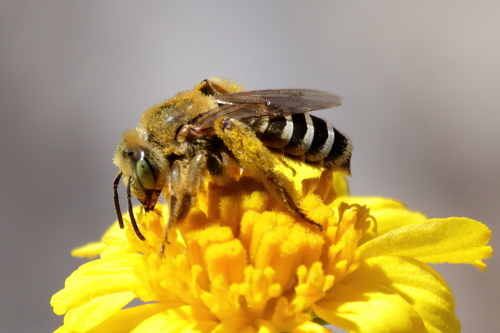
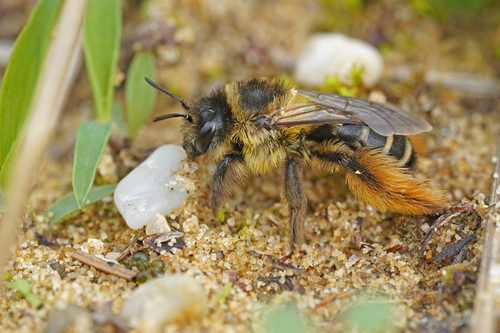
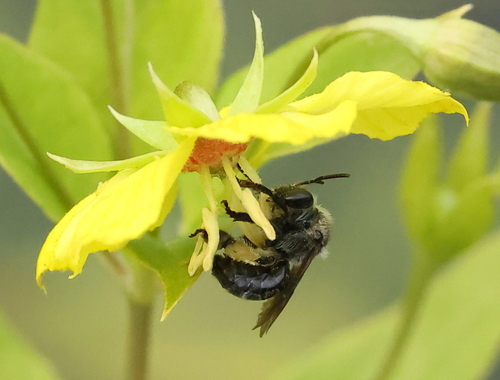
For identification, both male and female Macropis nuda measure approximately 7 to 7.5 millimeters in body length. M. nuda constructs compact, relatively shallow underground nests, where the deepest nesting cells reach no more than 6.5 millimeters below the ground surface. Nest entrances are usually hidden by dried leaves, twigs, rocks, or low-growing plants. Burrows have a diameter of roughly 3.0 to 3.5 millimeters, and are lined with a waterproof coating made from floral oils collected by female M. nuda. This lining keeps humidity stable within the nest for developing offspring. Nest cells are also coated with this same waterproof lining to keep them dry while offspring overwinter inside their cocoons. M. nuda is native to northern North America. It is an oligolectic bee, meaning it only occurs in areas where its host plant, Lysimachia ciliata, grows, and it is only found in the northern part of this host plant’s total range. Historically, M. nuda has been recorded across a range extending from British Columbia, Idaho, and Utah in the west, east to Newfoundland and New Jersey. Current evidence suggests that this species’ range may be shrinking as a result of climate change. M. nuda is a solitary bee species. Each female constructs her own underground nest, and the species is univoltine, producing only a single brood each mating season. Offspring hibernate within the nest over winter, and do not finish maturing until the following season. Both male and female M. nuda spend the winter inside cocoons as fully developed pupae, and resume development in spring when temperatures rise. After emerging as adults, young females will either locate a new nesting site or take over an existing old nest.