About Macropidia fuliginosa (Hook.) Druce
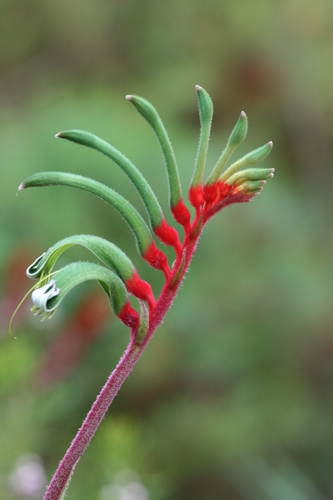
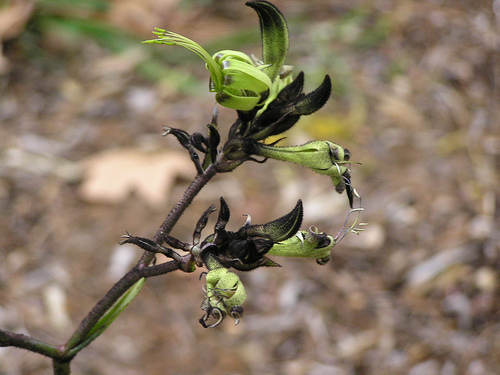
Macropidia fuliginosa (Hook.) Druce is a small perennial herb with erect green-yellow leaves. Its leaves are strap-like, flattened, between 315 and 460 mm long and 10 to 15 mm wide, arranged tightly at ground level. Leaves emerge from an underground rhizome, which lets the plant regenerate after fire. The flowering scape reaches around one metre in height; flowers bloom in spring and summer on branched stems that may reach one metre or more in length. Black hairs grow along the flowers and stems. The black and green coloration of its inflorescence is unusual among Australian plants, only seen in a few grevillea species and another south-western species, Kennedia nigricans (black kennedia). Its perianth curves backward in an irregular shape, forming a tube 12 to 18 mm long, with a total perianth length of 50 to 60 mm. This species is classified as 'not threatened' under Western Australian Flora Conservation Taxa. It is distributed in the Southwest Australia bioregion, ranging north from Muchea to Walkaway. It favors low mallee and heath vegetation growing on white or lateritic sand. Its populations are uncommon and widely dispersed, usually occurring as isolated individuals rather than grouped in clumps. In the wild, it is pollinated by nectar-feeding birds, with observed pollinators belonging to the Meliphagidae (honeyeater) family: the tawny-crowned honeyeater Gliciphila melanops, singing honeyeater Gavicalis virescens, brown honeyeater Lichmera indistincta, and white-cheeked honeyeater Phylidonyris niger. Like many Australian native plants, it can survive wild bushfire. When affected by disease, it can be burned back to the ground and will regrow from its rhizome. It is susceptible to fungal diseases, including ink-spot fungus and the rust fungus Puccinia haemodora. While it can be grown from seed for cultivation, germination is difficult. Commercial production uses tissue culture for propagation instead. It is not as widely propagated as the kangaroo paws of the genus Anigozanthos, whose species are hardier and more successfully cultivated.