About Macronyx capensis (Linnaeus, 1766)
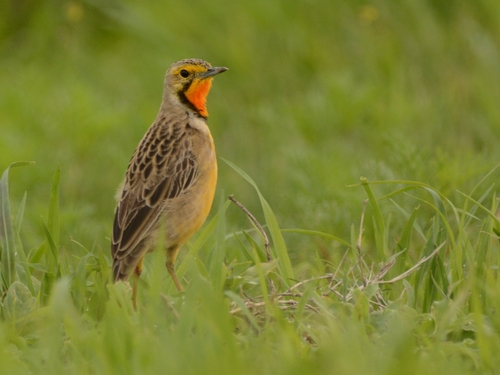
The Cape longclaw, scientifically named Macronyx capensis (Linnaeus, 1766), measures 19 to 20 centimetres in length. Adult males have a grey head with a buff supercilium, a streaked blackish back, a bright orange gorget, a black breast band, and yellow underparts everywhere else. Females are duller in colour, with a yellow throat and a much weaker breast band. Juveniles have a dirty yellow throat, an indistinct breast band, and yellowish-white underparts. The Cape longclaw is most often seen alone, and it does not typically occur in groups larger than two. It is usually found in pairs throughout the rest of the year, most commonly a breeding pair. It feeds on the ground, eating a diet of insects and some seeds. Its song is a musical cheewit cheewit, its contact call is tsweet, and it also produces a mewling alarm call. A common behavioural trait of this species is that it tends to stand on top of stones, anthills, or large grass clumps. When doing this, the birds stand upright with their breasts extended. This species bears a striking resemblance to unrelated American grassland icterid meadowlarks, a similarity that is thought to come from convergent evolution.