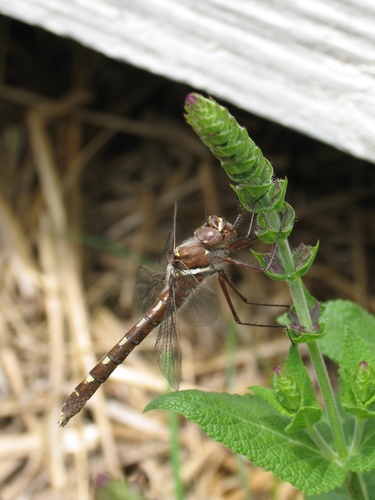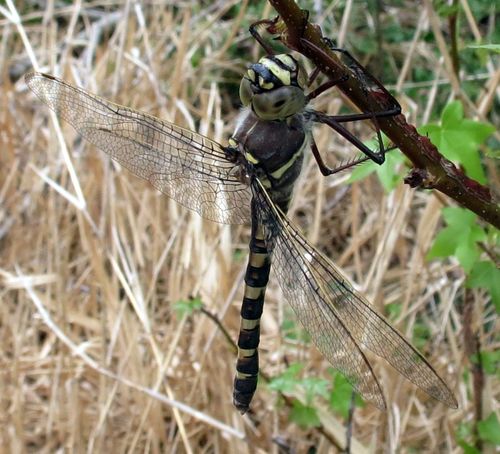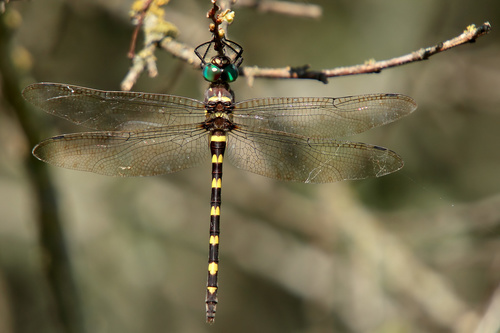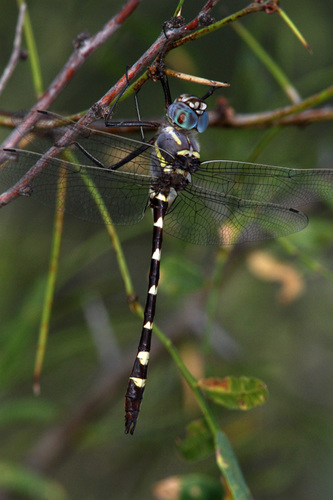
About Macromia alleghaniensis Williamson, 1909
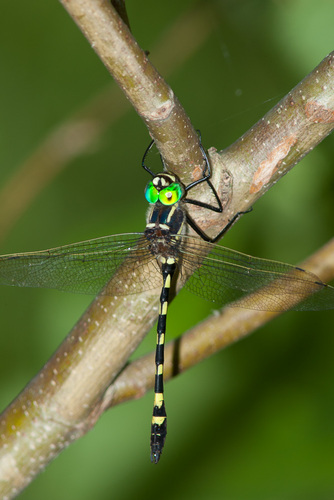
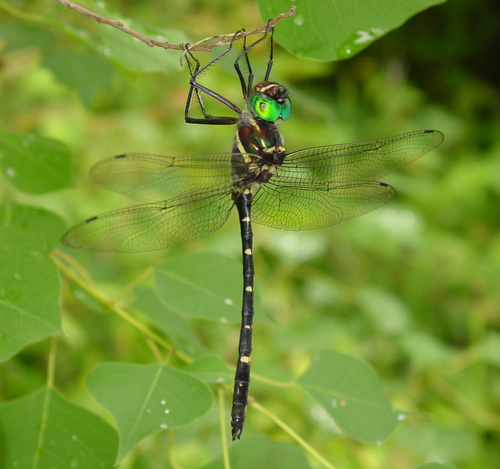
Macromia alleghaniensis, described by entomologist Edward Bruce Williamson in 1909, was previously confused by Williamson with Macromia illinoiensis, also called the Swift river cruiser. This species has often been confused with M. illinoiensis. Members of the Macromia genus have very similar wings, making identification of these two species difficult across the United States and Canada. When researchers observed subtle differences in yellow markings between the two species, they found that M. alleghaniensis has a larger geographic distribution than was previously thought. For identification, adult M. alleghaniensis are 66 to 71 mm (2.6 to 2.8 inches) long, with green eyes. The thorax lacks frontal stripes, and the abdomen bears yellow spots. Females resemble males, but have a distinctly cylindrical abdomen. Accurate identification can be done by examining the specimen directly or studying its genitalia; M. alleghaniensis has a nearly complete yellow ring on the second abdominal segment. This species is most commonly found in the central southeastern United States. Its range extends west to southeastern Missouri, and continues into western Arkansas, Oklahoma, Texas, reaching the Gulf coast along the border of Mississippi and Alabama. Rare occurrences have been recorded in Georgia, Florida, and South Carolina. The species is uncommon across the northern portion of its range. It is considered rare and of special concern in New Jersey, critically imperiled in Pennsylvania, rare and critically imperiled in Maryland, rare in Virginia, rare in need of conservation in Ohio, and critically imperiled in Illinois. A population was first discovered in Michigan in 2014. M. alleghaniensis typically inhabits small to medium-sized slow-flowing streams. The International Union for Conservation of Nature (IUCN) assessed this species in 2017 and assigned it the conservation status of LC (Least Concern), meaning there is no immediate threat to the species' survival and its population is currently stable.