About Macrodactylus subspinosus (Fabricius, 1775)
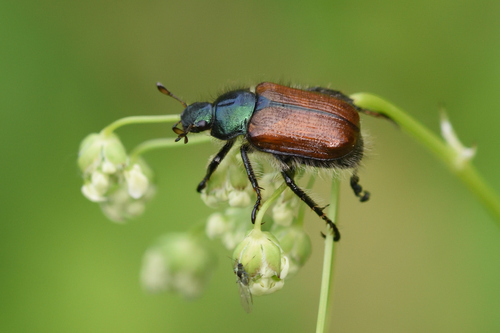
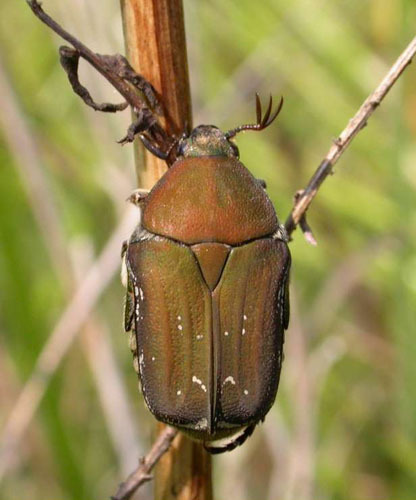
The rose chafer, Macrodactylus subspinosus, has a yellowish-tan body 8–13 millimetres (0.3–0.5 in) long, with wings that do not fully cover the abdomen. It has six long, spiny, reddish-brown legs that darken gradually toward the tips, two short lamellate antennae ending in a club of flat plates, and chewing mouthparts. The entire body is covered in dull yellow hairs that give it its characteristic colour. As beetles age and go about normal activity, hairs wear away from the head and thorax, revealing black colour underneath, so older beetles can be distinguished from younger ones by their fewer hairs and darker overall colour. Females typically lose more hair than males, especially on the thorax from the mating process, so they also often appear darker in colour. Females are also generally more robust than males. Rose chafer eggs are approximately 1 mm long, oval, white, and shiny. Larvae are white C-shaped grubs; when mature, they develop a brown head capsule and three distinct pairs of legs. Pupae are yellowish-brown and around 15 mm in length. As a member of the order Coleoptera, the rose chafer goes through complete metamorphosis during development. After overwintering deep in soil, white-bodied larvae around 18 millimetres (0.7 in) long pupate in late May. After adults emerge from the pupal case, they live for 3–6 weeks, feeding on plant material and mating during this time. Females lay eggs 15 centimetres (6 in) deep in sandy soils, and eggs hatch after 1–3 weeks. This new generation of larvae feeds on the roots of grasses, weeds, and some ornamental garden plants for the rest of the summer, then burrows deep into soil to overwinter. These overwintering larvae will emerge as adults the following year.