About Macrocypraea zebra (Linnaeus, 1758)
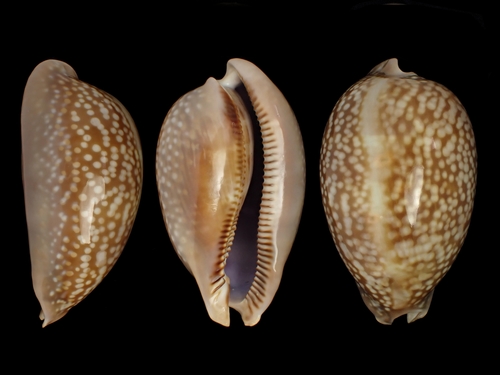
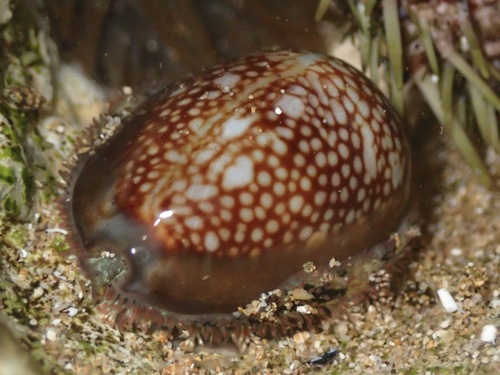
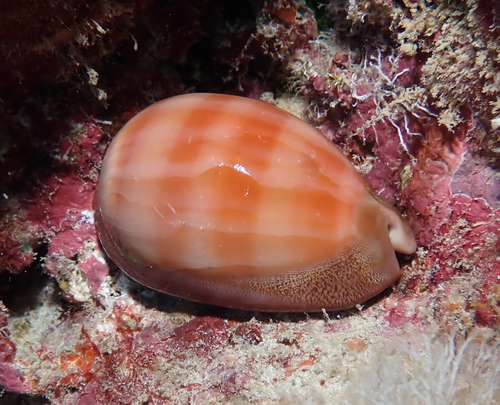
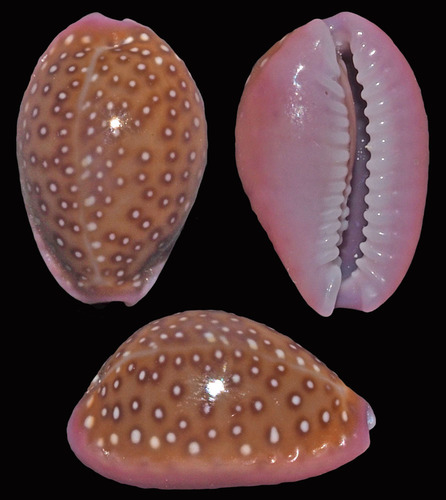
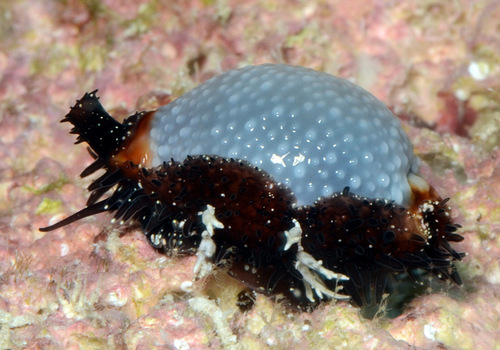
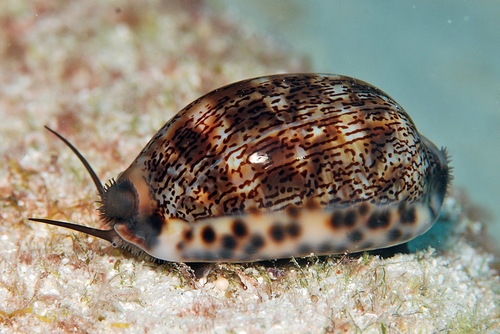
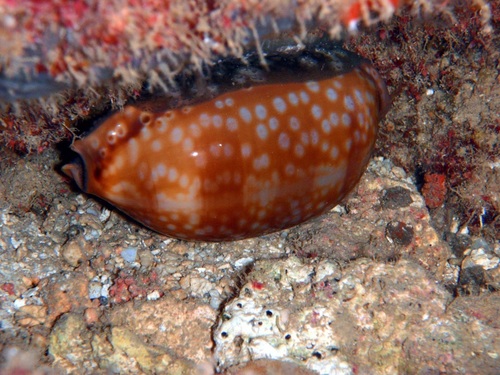
This entry covers Macrocypraea zebra (Linnaeus, 1758), a species of cowry. These are fairly uncommon cowries. Their shells have an average length of 60–70 millimetres (2.4–2.8 in), with a minimum recorded size of 32 millimetres (1.3 in) and a maximum recorded shell length of 133 millimetres (5.2 in). Shells are usually long-oval in shape, with a smooth and shiny dorsum surface. The basic shell color is brown, and usually marked with three wide dark brown transverse bands, several bluish-white spots, and a light gray longitudinal mark on the top sulcus. On the shell sides, the white spots are ocellated, with a small dark brown spot at the center of each spot. The base of the shell is pale brown. The long, narrow aperture typically has long dark brown labial teeth, and the shell interior may be purple. Macrocypraea zebra is quite similar to Macrocypraea cervus and Macrocypraea cervinetta, but it can be easily distinguished from these two species in side view by its ocellated spots, which are absent in the other two species. In living Macrocypraea zebra cowries, the mantle is greyish, with short sensory papillae. The mantle can cover the entire shell, and can be withdrawn into the shell opening when the cowry is threatened. This species is distributed in the Atlantic Ocean, along North Carolina, Florida, the Caribbean Sea, the Gulf of Mexico, the West Indies (as far east as Barbados), and Brazil. They live in tropical low intertidal and subtidal waters, usually on coral reefs or under rocks. The minimum recorded depth for this species is 0 m, and the maximum recorded depth is 37 m.