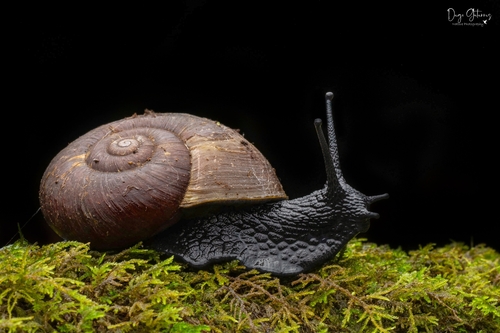
About Macrocyclis peruvianus (Lamarck, 1822)
Macrocyclis peruvianus (originally described by Lamarck in 1822) is a large land snail. It has a shiny black body and a reddish-brown shell. The shell has a depressed, short spire, 4.5 to 5 whorls that grow rapidly in size, and reaches up to 60 mm in diameter. The shell's aperture is ovate, and its lip is overturned and widened at the base. This species is endemic to Chile and adjacent areas of Argentina. It is the largest land snail species found in Chile, where it occurs from the O'Higgins Region in the north to the Aysén Region in the south. It is most abundant in native forests of the Andean foothills' coastal range, particularly in Nothophagus, evergreen, and mixed forests. It can also be found in plantations, sclerophyllous forests, and hygrophyllous forests. Within its native range, M. peruvianus lives in leaf litter in areas that have abundant ferns, mosses, decaying wood, and a thick understory. Its overall diet is still poorly understood, but it is confirmed to feed on multiple mushroom species and other snails. One of its main predators is the land planarian Polycladus gayi.

