About Macroctopus maorum (Hutton, 1880)
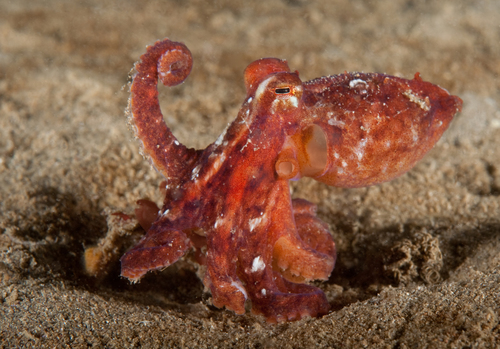
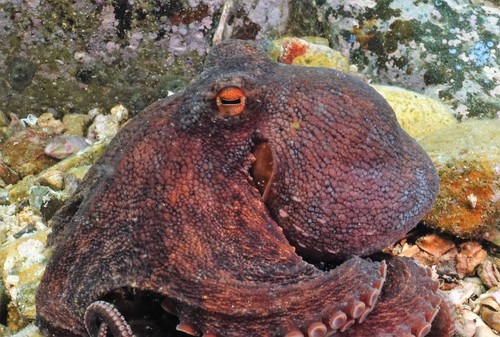
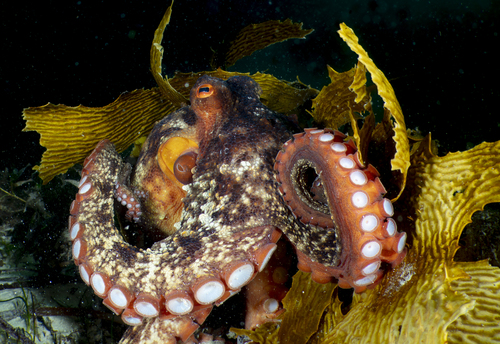
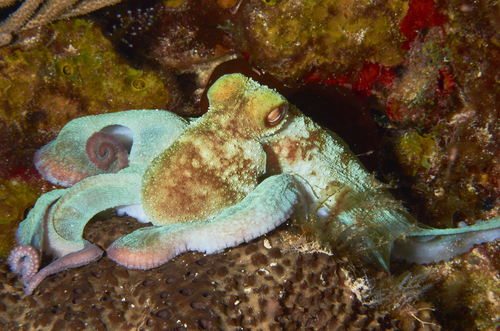
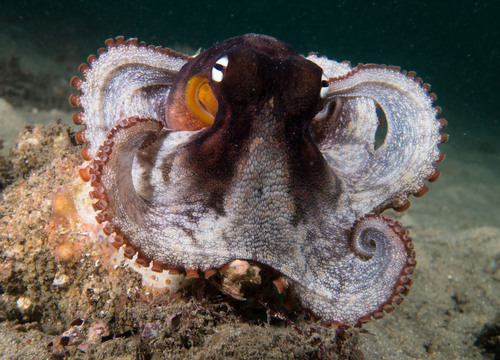
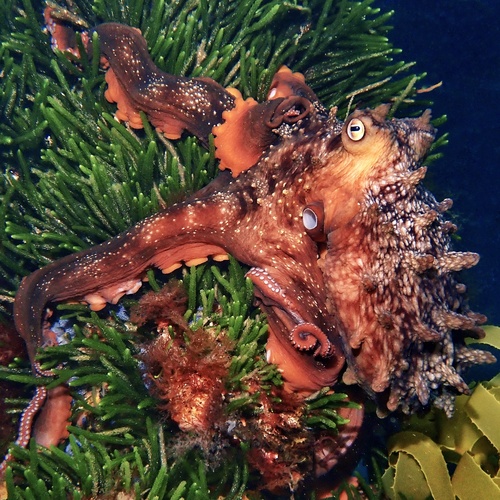
Macroctopus maorum is a large, robust octopus, and is a member of the Octopus macropus species complex. This complex is defined by characteristic morphological traits: a high number of gill lamellae, a robust conical copulatory organ, and arms of varying length, with long, unequal dorsal arms that are generally four to six times longer than the mantle. While unequal in length, all arms of M. maorum are long and evenly tapering, and individuals are able to regrow arms that have been lost. As the largest member of its complex, M. maorum can have an arm span exceeding 3 metres (9.8 ft). Suckers are arranged in two rows along the length of each arm; the first and second arm pairs have four to six suckers that usually reach about 40 millimetres (1.6 in) in size. There is no confirmed correlation between sex and sucker size, but sucker size does increase with increasing body mass. The coloration of M. maorum is variable, but the species can be distinguished from others by its consistent coloration options: it appears either orange-brown or dark purple-grey. The octopus has numerous small iridescent white spots across its web, arms, and dorsal arm crown, but there are no spots present on its mantle. M. maorum has 12–14 gill lamella per demibranch. Its mantle is broadly ovoid, with a skin pattern of longitudinal ridges. Five rows of unbranched papillae run along the dorsum, and two additional individual papillae sit above the eyes. Octopus papillae are specialized for camouflage, and can change shape by extending in and out from the body. Male M. maorum have a small ligula, which is a specialized arm tip on the hectocotylized arm that grips to transfer spermatophores. In a study that estimated M. maorum size from a sample of 90 beaks, the largest individual found had a total body length of 2.0 metres (6 ft 7 in) and a body mass of 12 kilograms (26 lb). Like other octopuses, M. maorum has an upper and lower beak. The upper beak can be used to distinguish M. maorum from Enteroctpus zealandicus, as the two species have no overlap in the ratio of upper hood length to upper chest length. M. maorum hatchlings usually measure about 5.06 millimetres (0.199 in) at hatching; they have 7–8 suckers per arm, and each dorsal arm has 6–11 chromatophores. M. maorum is commonly found in the waters of New Zealand and South Australia, and prefers temperate to sub-antarctic waters. In New Zealand, it occurs off the coasts of both the North and South Islands, and is one of the most common octopus species in the country. It is also common in waters around New Zealand's outlying islands, including Campbell Island, Chatham Islands, and Auckland Islands. In Southeast Tasmania, Eaglehawk Bay (the site of a commercial fishery) is the only known inshore location where M. maorum gather in large numbers year round. M. maorum lives in the benthic zone, inhabiting soft-sediment and rubble habitats at depths from 0 to 549 metres (0 to 1,801 ft). It will sometimes forage in nearby hard-reef habitats, and is less common at the boundaries between reefal and soft sediment habitats. Rather than settling in a single permanent location, M. maorum uses temporary shelters. In Tasmania, young M. maorum have been observed settling in intertidal rock pools. Similar sightings of M. maorum in intertidal rock pools have also been reported during summer months at Kaikoura and Banks Peninsula.