About Macrochelys temminckii Troost, 1835
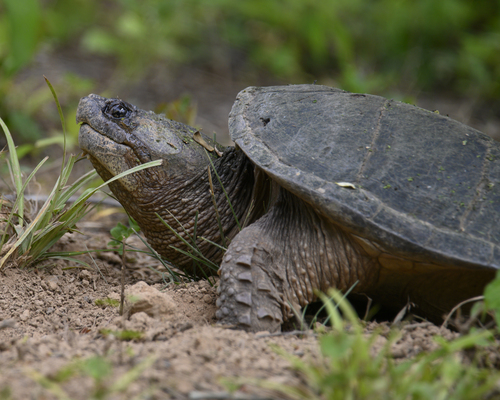
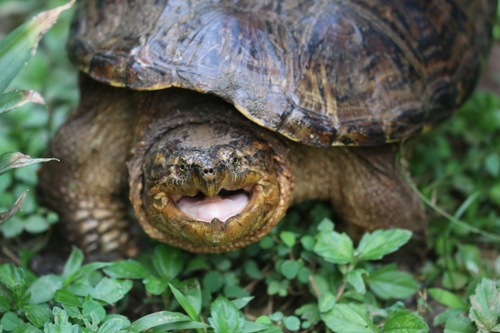
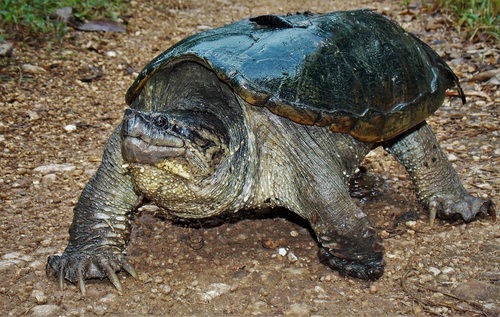
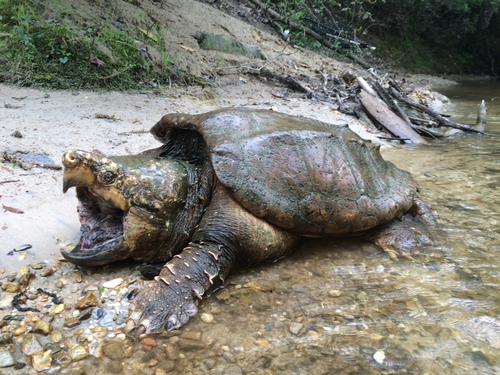
Macrochelys temminckii, commonly known as the alligator snapping turtle, has a large, heavy head and a long, thick shell with three dorsal ridges of large scale-like osteoderms, giving it an appearance similar to armored ankylosaurs. It can be immediately told apart from the common snapping turtle by its three distinct rows of spikes and raised plates on the carapace; the common snapping turtle has a much smoother carapace instead. The spikes on the alligator snapping turtle's carapace gradually flatten as the turtle ages. This species is usually solid gray, brown, black, or olive-green, and individuals are often covered in algae. It has radiating yellow patterns around the eyes that break up the eye outline to improve camouflage, and the eyes are also surrounded by a star-shaped arrangement of fleshy, filamentous "eyelashes". Unconfirmed reports note a 183 kg (403 lb) alligator snapping turtle found in Kansas in 1937, but the identity of the largest verifiable specimen is still debated. One 16-year resident giant individual, weighing 113 kg (249 lb), was held at Chicago's Shedd Aquarium before being sent to the Tennessee Aquarium as part of a 1999 breeding loan, where it later died. Brookfield Zoo, in suburban Chicago, housed another specimen that weighed 107 kg (236 lb), and another large report mentions an individual weighing 135 kg (298 lb). The species does not generally reach these extreme sizes. Individuals reach breeding maturity at around 8 kg (18 lb), when their straight carapace length is around 33 cm (13 in), and the species continues growing throughout its entire life. Excluding exceptionally large specimens, adult alligator snapping turtles typically have a carapace length between 35 and 80.8 cm (13.8 to 31.8 in) and weigh between 8.4 and 80 kg (19 to 176 lb). Males are typically larger than females. Average weights from different population samples are 21.05 kg (46.4 lb) for 88 adults, 19.72 kg (43.5 lb) for 92 adults, and 13.5 kg (30 lb) for 249 adults. Most population studies note that specimens weighing over 45 kg (99 lb) are almost always very old males. Among living freshwater turtles, only the little-known giant softshell turtles of the Asian genera Chitra, Rafetus, and Pelochelys reach comparable sizes. In mature specimens with a straight carapace length over 30 cm (12 in), males and females can be distinguished by the position of the cloaca relative to the carapace, and by the thickness of the tail base. A mature male's cloaca extends beyond the edge of the carapace, while a female's cloaca sits exactly on the edge, or even closer to the plastron. The base of the male's tail is also thicker than the female's, to accommodate hidden reproductive organs. The inside of this turtle's mouth is camouflaged, and it has a worm-shaped (vermiform) appendage on the tip of its tongue that it uses to lure fish, an adaptation of aggressive mimicry. Research suggests that the species' unique head shape reflects strong natural selection for bite performance, which can directly or indirectly affect fitness. A 2023 study recorded bite force for this species ranging from 8.2 to 1872 Newtons, with bite force heavily dependent on individual size. Research also indicates that M. temminckii thermoregulates by changing its depth within the water column, as the species is rarely observed basking. This turtle must be handled with extreme care, as it is considered potentially dangerous: it can bite through a broom handle, and rare cases have been recorded where the species cleanly bit off human fingers. No human deaths have been reported to be caused by the alligator snapping turtle. Alligator snapping turtles are found primarily in freshwater habitats of the southeastern United States, ranging from the Florida Panhandle west to East Texas, and north to southeastern Kansas, Missouri, southeastern Iowa, western Illinois, southern Indiana, western Michigan, western Kentucky, Louisiana, and western Tennessee. They are generally found only in bodies of water that drain into the Gulf of Mexico, and usually do not live in isolated wetlands or ponds. The species often uses core sites defined by specific microhabitat features: abundant structural cover including cut banks, root balls, and submerged trees, plus dense canopy cover. Studies confirm that turtles prefer sites with canopy cover, overhanging trees, shrubs, dead submerged trees, and beaver dens. Only nesting females typically venture onto open land. Within their habitats, individuals use core sites, and females tend to have larger movement patterns and larger home ranges than males; the average home range for an individual is 750 m (2,460 ft). This species reaches maturity around 12 years of age. Mating occurs once per year: in early spring in the southern part of its range, and in late spring in the northern part. Around two months after mating, the female builds a nest and lays a clutch of 10 to 50 eggs. Some females lay eggs every year, while others lay eggs every other year. The sex of hatchlings is determined by the incubation temperature of the eggs, a system called temperature-dependent sex determination that is used by all turtle species. For alligator snapping turtles, higher incubation temperatures produce more males in a clutch. Nests are usually dug at least 50 yards from the water's edge to prevent flooding and egg drowning. Incubation lasts between 100 and 140 days, and hatchlings emerge in early fall. While the potential lifespan of wild alligator snapping turtles is not confirmed, the species is thought to be able to live up to 200 years of age, though a lifespan of 80 to 120 years is considered more likely. In captivity, individuals typically live between 20 and 70 years.