About Macrobrachium rosenbergii (De Man, 1879)
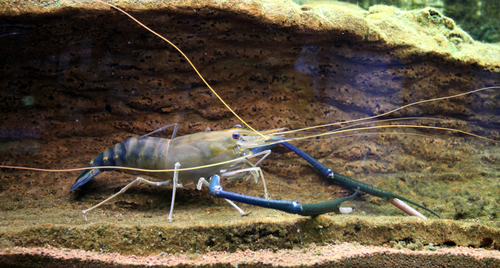
Macrobrachium rosenbergii can grow to over 30 centimeters (12 inches) in total length. Mature males reach an average maximum length of 34 centimeters (13 inches), while mature females reach 26 centimeters (10 inches). Females can be told apart from males by their wider abdomens and smaller second pereiopods, the walking legs that bear the pincer-like chelae. Male genital openings are located on the body segment holding the fifth pereiopods, and female genital openings are located on the segment holding the third pereiopods. The species is predominantly brownish in color, though coloration can vary between individuals. Smaller specimens are often greenish and have faint vertical stripes. Its rostrum is very prominent, and holds 11 to 14 dorsal teeth and 8 to 11 ventral teeth. The first pair of walking legs is elongated and very thin, ending in small delicate claws called chelipeds that the animal uses for feeding. The second pair of walking legs is much larger and more powerful, particularly in males. The movable claws of this second pair are covered in dense bristles called setae that give them a distinctive velvety appearance. In males, the color of these claws changes based on the individual’s social dominance rank.
During mating, a male deposits spermatophores on the underside of a female’s thorax, between her walking legs. The female then releases her eggs, which pass through the deposited spermatophores to be fertilized. The female carries the fertilized eggs attached to her body until they hatch; carrying time varies but is generally less than three weeks. Females can lay between 10,000 and 50,000 eggs per brood, and can produce up to five broods per year. Fertilized eggs hatch into zoeae, the first larval life stage of crustaceans. The larvae go through multiple developmental stages in brackish water before undergoing metamorphosis into post-larvae. At this stage, post-larvae measure 7.1 to 9.9 millimeters (0.28 to 0.39 inches) long and already look like adult individuals. Metamorphosis to the post-larval stage typically occurs 32 to 35 days after hatching. Once they have become post-larvae, the young animals migrate back into freshwater habitats.