About Macrobdella decora (Say, 1824)
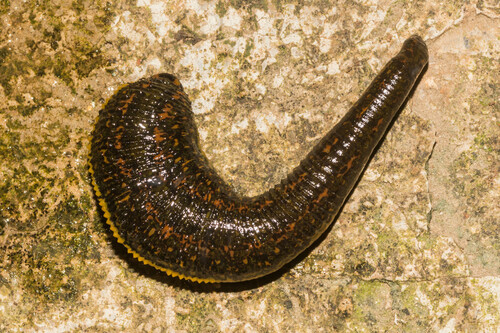
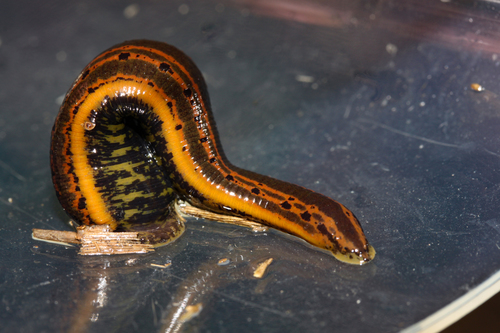
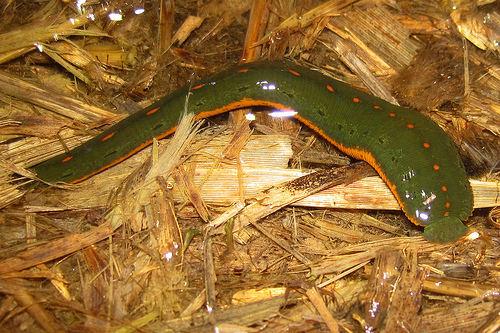
Macrobdella decora (Say, 1824) is a medium-sized leech. Based on measurements of six specimens, adult individuals grow to between 5 and 8.5 cm (2.0 and 3.3 in) long, and weigh between 1.5 and 3.7 grams (0.053 to 0.131 oz). Its back is typically dark green, brown, or olive-green, marked with a line of roughly 20 small orange or red dots running along the midline, paired with two matching rows of black dots along its sides. Its underbelly is reddish or orange, with irregularly scattered black spots. The back of this leech is rounded, while the belly is flattened. All leech species have 32 body segments, but these segments are hidden by many small external ring-like markings called annuli; Macrobdella decora has a total of between 90 and 94 annuli.
It is the most widely distributed species in the genus Macrobdella, found across North America east of the Rocky Mountains, in southern Canada and the adjacent United States. It has one isolated population in Nuevo León, Mexico. For the most part, this species does not occur south of Virginia, where Macrobdella ditreta is the dominant leech species in the southern United States. However, M. decora has been recorded in the southern Appalachian Mountains of Georgia and South Carolina. Its range extends west as far as Alberta, North Dakota, Nebraska, Colorado, and New Mexico, and it is also found on Prince Edward Island at the eastern edge of its range.
It was originally thought that M. decora was possibly panmictic – meaning individuals mix and breed randomly – across most of its range. However, populations in Ontario and New England do not exhibit panmixia. A 2024 phylogeographic study that examined the species' geographic genetic diversity concluded that we cannot assume M. decora is truly panmictic across its full range, and that more research on this topic is needed.
M. decora is a strictly freshwater species, occurring in still or slow-moving water bodies including streams, temporary ponds, ditches, and wetlands. It is particularly abundant in temporary ponds, because these leeches can burrow into the pond bottom when the pond dries out to survive. They can survive for short periods on land, and have been found up to 30 metres (98 ft) away from the aquariums they were kept in. They may also move onto shore by attaching to a terrestrial host such as a mammal or bird. Even so, their overland dispersal ability is assumed to be limited. In lakes, this leech is most active in the epilimnion, the uppermost layer of lake water.
NatureServe has classified the species as Secure within Ontario, but no formal conservation assessment has been completed for other regions. A 2021 paper focused on the species' gut microbiome described M. decora as unendangered. As of October 2025, M. decora was the most frequently observed leech species on the citizen science platform iNaturalist in Canada, and the second-most observed leech species in the United States, following Placobdella parasitica.
For reproduction, these leeches fully engorge with blood before mating. One to two months after feeding, they produce pale yellow, elliptical, spongy cocoons. Young leeches emerge around one month after cocoon production, and measure only 20 to 22 millimetres (0.79 to 0.87 in) long when they hatch. They require several years to reach full sexual maturity.