About Macquaria novemaculeata (Steindachner, 1866)
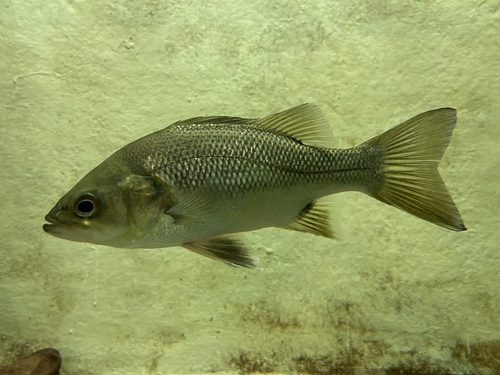
Australian bass (Macquaria novemaculeata) have a moderately deep, elongated body that is laterally compressed. They have a forked caudal (tail) fin, angular anal fins and angular soft dorsal fins; their spiny dorsal fin is relatively high, strong, and sharp. They have a medium-sized mouth and relatively large eyes, which can appear dark in low light or red in bright light. The gill covers (opercula) of Australian bass have extremely sharp flat spines that can cut fishermen's fingers deeply. Their colour ranges from metallic gold in clear sandy streams to the more common bronze or bronze-green colour in streams with darker substrates and/or tannin-stained water. Overall, Australian bass are a relatively small species. Wild river Australian bass average 0.4–0.5 kg (0.88–1.10 lb) and 20–30 cm (7.9–11.8 in); a wild river individual weighing 1 kg (2.2 lb) or more is considered a good specimen. The maximum recorded size in rivers is around 2.5 kg (5.5 lb) and 55 cm (22 in) in southern waters, and around 3 kg (6.6 lb) and 60–65 cm (24–26 in) in northern waters. Australian bass stocked in non-breeding man-made impoundments reach greater average and maximum weights than wild river Australian bass.
Australian bass are found in coastal rivers and streams from Wilsons Promontory in Victoria, east and north along the eastern Australian seaboard to rivers and creeks of the Bundaberg region in central Queensland. They are not present in the Murray-Darling system. Despite being extensive, the Murray-Darling system ends in a sequence of coastal lakes and lagoons with only one shallow, changing entrance to the Southern Ocean — features that do not match the estuarine breeding habits of Australian bass and other parts of their life cycle.
During warmer months, Australian bass live in the freshwater reaches of coastal rivers, and require reasonably good quality, unsilted habitats with sufficient native riparian vegetation and in-stream cover. They generally stay in cover during the day, and are quite flexible about the type of cover they use. Common types of cover include sunken timber (snags), undercut banks, boulders, shade from overhanging trees and bushes, and thick weedbeds. This cover does not need to be in deep water; Australian bass readily use cover in water as shallow as 1 metre deep. Australian bass of all sizes are strong swimmers and can easily move through rapids and fast-flowing water, but they generally avoid staying directly in currents to conserve energy. At night, Australian bass exhibit pelagic (near-surface) behaviour and actively hunt prey in shallow water and at the water's surface. When they aggregate to spawn in the broad reaches of estuaries during winter, Australian bass are less focused on cover and generally stay in deeper water.
Australian bass are sexually dimorphic. Males typically reach an absolute maximum size of 1 kg (2.2 lb) or less, while females regularly grow larger than 1 kg (2.2 lb) and sometimes reach the maximum 2.5–3 kg (5.5–6.6 lb) size. Males reach sexual maturity at 3 or more years of age, while females reach sexual maturity at 5–6 years of age. Australian bass spawn in estuaries during winter, most often in July or August. There is uncertainty about the salinity levels preferred for spawning. Estuaries are dynamic habitats with daily salinity changes from tides, and are also affected by droughts, floods, and freshes (minor, temporary flow rises), making it hard to measure the preferred spawning salinity for wild Australian bass. However, based on captures of recently spawned larval and juvenile Australian bass in estuaries, the species appears to spawn in a salinity range of 8–12 parts per thousand (full salt water is approximately 36 ppt). Australian bass sperm have no viability at or below 6 ppt, and are most viable at 12 ppt, which is likely the most relevant fact. There are also reports of Australian bass spawning in salinities of 12–18 ppt, based on fishermen's observations of wild spawning and some unpublished data collected by the NSW Fisheries Department. Artificial breeding of Australian bass is done at much higher salinities than occur in natural spawning.
Australian bass are highly fecund. The mean fecundity (fertility) recorded from examined mature wild females is 440,000 eggs, and one very large individual produced 1,400,000 eggs. At natural spawning salinities, the eggs are described as demersal (sinking), so estuarine vegetation such as seagrass almost certainly plays an important role in trapping and protecting eggs. Larvae hatch 2–3 days after spawning. Juvenile Australian bass migrate to the freshwater reaches of rivers after spending several months in estuarine waters. Even though they spawn in estuaries, Australian bass depend on river floods flowing into estuaries through the winter; these floods stimulate adult migration and spawning, and create increased productivity that supports strong larval survival and recruitment.
During winter spawning in flood periods, both adult and larval Australian bass may enter the sea (larvae may do this involuntarily). The presence of field-caught larvae of both species on incoming tides in Swansea Channel indicates that the larvae have spent some time in the ocean. Adult Macquaria novemaculeata move downstream into estuaries to spawn in water of suitable salinity. In low rainfall years, the spawning location is further upstream than in wet years; in wet years, spawning can occur in shallow coastal waters adjacent to estuaries (Searle, pers. comm.). In wet years, mature M. novemaculeata adults can be found outside of estuaries (Williams, 1970). This is verified by the trawl collection of mature adults in July 1995 in 11–17 m of water off Newcastle, NSW (AMS I.37358-001). This movement leads to some genetic interchange between river systems, which is important for maintaining a high degree of genetic homogeneity (sameness) in Australian bass stocks and preventing speciation. However, this movement has not stopped distinct genetic profiles and subtle morphological (body shape) differences from developing in different river systems. These findings, along with research showing significant differences in the seasonal timing of spawning and migration in far southern populations, highlight the importance of using appropriate regional Australian bass stocks for artificial breeding and stocking projects.