About Macquaria ambigua (Richardson, 1845)
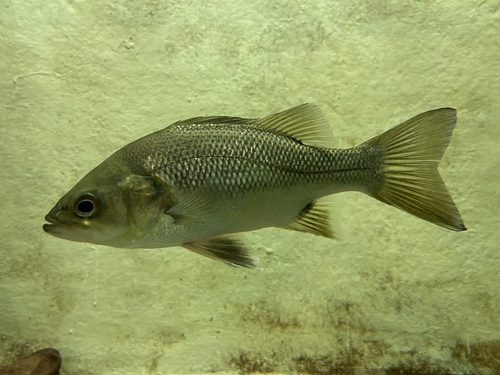
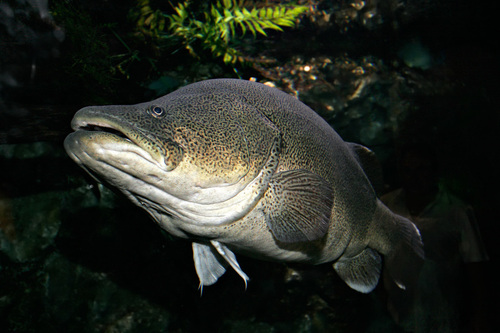
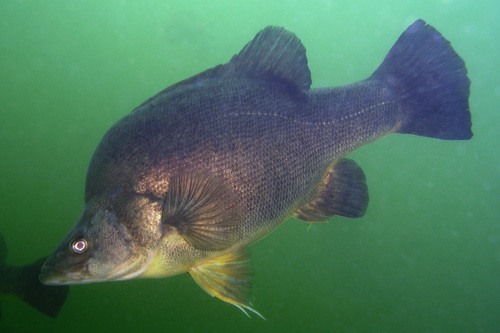
Macquaria ambigua, commonly known as golden perch, are a medium-sized fish species. In river environments, they commonly reach 30–40 cm in length and 1–2 kg in weight, while individuals from rivers are smaller and somewhat streamlined. In comparison, golden perch in man-made impoundments have much deeper bodies, and reach much greater average and maximum sizes. The maximum recorded size for golden perch in rivers is 9 kg, while the maximum recorded size in impoundments is 15 kg. A 24-kg fish caught from Kow Swamp, Victoria in the early 1900s was labelled and sold as "Murray perch", and is often cited as the largest recorded golden perch. This record is considered doubtful: it far exceeds all other size records for golden perch, and the specimen is far more likely to have been a Murray cod (Maccullochella peelii), a species that grows to much larger sizes than golden perch. Golden perch have an elongated, deep but laterally compressed body, with a sizeable mouth, small to moderate-sized eyes, a distinct curve to the forehead, and a distinct "hump" above the head. Their gill covers (opercula) have a small, flat spine sharp enough to cut the fingers of unwary fishermen. The caudal fin, soft dorsal fin, and anal fin are rounded, while the spiny dorsal fin is short to moderate in length and strong. Their colour varies from pale silvery-gold in turbid waters to deep yellow/gold or bronze-black in very clear waters. Golden perch are primarily native to the lowland reaches of the Murray–Darling River system, but they also extend far into slope habitats and occasionally even lower upland reaches. Within the Murray–Darling system, golden perch are often found living in sympatry with Murray cod. The genus Macquaria, which includes golden perch, follows the pattern of Murray–Darling native fish genera: diversification into more generalist lowland species and more specialist upland species. Golden perch (M. ambigua) are the lowland species in this group, while the closely related Macquarie perch (M. australasica) is the more specialised upland species that once inhabited the upland reaches of the southern Murray–Darling basin. This endangered Macquarie perch has now been almost entirely displaced by introduced trout species, dams, associated effects such as cold-water pollution, and habitat degradation or modification. Like many native fish of the Murray–Darling system, golden perch have moved between river catchments through natural river capture and connection events. Golden perch are also naturally found in the Fitzroy–Dawson River in central Queensland, and the internal Lake Eyre–Cooper Creek drainage system of Central Australia. The species has also been successfully introduced to other river systems in the Northern Territory, Queensland, and New South Wales, which has complicated studies of its natural native range. Introductions into Western Australia have been unsuccessful. The non-Murray–Darling populations have been isolated from Murray–Darling populations long enough that genetic drift and natural selection have left them distinct; they are considered at least separate subspecies, and possibly separate species. The taxonomy of golden perch has not been updated to reflect this divergence, though the name Macquaria ambigua oriens, indicating subspecies status, has recently appeared in literature discussing the Fitzroy–Dawson population. Some research indicates that the Fitzroy River population is the ancestral golden perch population. In the Murray River, wild male golden perch generally reach sexual maturity at 3 years of age and 32.5 cm in length, while wild female golden perch reach sexual maturity at 4 years of age and 40 cm in length. This fact is a current concern because the existing minimum size limit for the species is 30 cm, which is less than 40 cm. Originally, spawning was thought to require temperatures close to 24 °C, but multiple field studies of this and other Murray-Darling fish species show that their required spawning temperature is flexible, and golden perch can and do spawn at lower temperatures. For example, fertilised drifting golden perch eggs have been netted in water temperatures as low as 16.9 degrees Celsius in the Barmah Forests region of the Murray River, with a full recorded spawning temperature range of 16.9 to 24.7 degrees. Golden perch have a flexible breeding strategy, but generally (though not always) require a spring or summer flood or "fresh" — a temporary within-channel increase in flow — to stimulate spawning. Like some other primarily lowland native fish species of the Murray–Darling river system, these floods or freshes appear to be necessary for good survival and recruitment of newly spawned fish. However, very small freshes appear to be sufficient for some spawning and recruitment. Golden perch are highly fecund: females between 2.2 and 2.4 kg produce about half a million eggs per spawning event, and fish above 2.5 kg produce well over that number. The eggs are generally planktonic, and hatch fairly quickly, within 24 to 36 hours. Like other Macquaria species, golden perch have sexual dimorphism: females generally reach much larger maximum sizes than males, and females also reach sexual maturity at older ages and larger sizes than males. Very long migrations are part of golden perch ecology, particularly before spawning. When flood conditions allow passage over weirs and other man-made obstructions, adult golden perch have been recorded migrating well over 1,000 km. Smaller migrations are important for the ecology and dispersal of juvenile fish. Evidence suggests that before European settlement, huge shoals of golden perch roamed the entire lowland and slope reaches of the vast Murray-Darling River system without obstruction. As a result, the gradual loss of fish passage caused by thousands of dams, weirs, locks, and other barriers — an estimated 4,000 barriers exist in the Murray-Darling system today — has had severe impacts on the species. Some major weirs have been modified to restore fish passage, however. Golden perch have unusually broad temperature tolerance, ranging from 4 to 37 °C, and unusually high salinity tolerance for a freshwater fish, up to 33 parts per thousand. Golden perch follow the trend of many native fish of southeast Australia in being very long-lived. Longevity is a survival strategy in the often challenging Australian environment, as it ensures that most adults participate in at least one exceptional spawning and recruitment event. These events are often linked to unusually wet La Niña years, and may only occur every one or two decades. The maximum recorded age for golden perch is 26 years.