About Macolor macularis Fowler, 1931
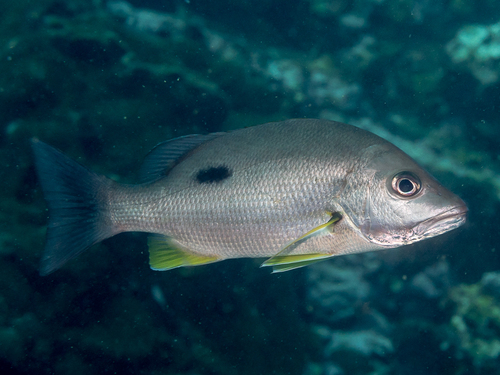
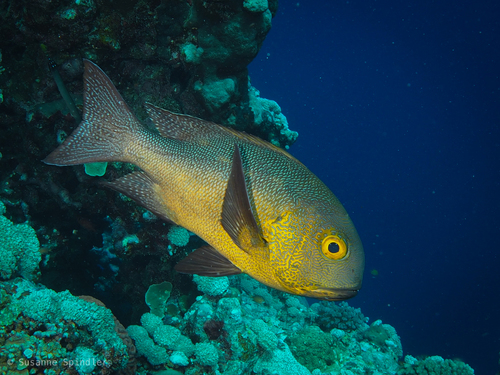
Macolor macularis Fowler, 1931 reaches a maximum total length of 60 cm (24 in). Adult individuals have an overall dark grey-brown color on the upper body that shades to yellow on the head and lower body. The head features thin blue lines and small spots, while the body scales bear blue lines or dashes. Juveniles have a black and white piebald pattern, including five white spots on the back. Subadults share a similar pattern to juveniles, but have many more white spots on the back and small white spots in the other black areas. Smaller adults retain faint traces of the juvenile patterning. This species has a moderately deep body, a noticeably convex forehead, and a large mouth. The preoperculum has a deep incision along its lower margin. The jaws hold a row of conical teeth, with the front teeth being enlarged. Inside the outer row, there are bands of bristle-like teeth on the sides of the upper jaw and the front of the lower jaw. Vomerine teeth form a roughly chevron-shaped patch. The dorsal fin has 10 spines and 13 to 14 soft rays, while the anal fin has 3 spines and 10 soft rays. The rear tips of both the dorsal and anal fins are clearly pointed. The long pectoral fins, which have 17 or 18 fin rays, extend as far as the level of the anus. The caudal fin is emarginate. Smaller juveniles, with a standard length of around 20 cm (7.9 in) or less, have very elongated pelvic fins. Macolor macularis has a wide distribution across the Indo-West Pacific, but its full range is not well understood due to historical confusion with Macolor niger. It has been recorded in the Chagos Islands, the Maldives, and southwestern India. In the Pacific, it occurs from the Andaman Sea and Sumatra east to Samoa and the Phoenix Islands, north to Taiwan and the Yaeyama Islands of southern Japan, and south to Australia. In Australian waters, this species is found on offshore reefs in northern Western Australia, Ashmore Reef in the Timor Sea, the Arafura Sea in the Northern Territory, and the Great Barrier Reef of Queensland. It also occurs around reefs in the Coral Sea and at Christmas Island. Adults live on the steep slopes of lagoon, channel, or seaward reefs, and are commonly found on deep reef slopes. Juveniles live solitarily on sheltered reef slopes, found among crinoids, in staghorn coral, or within large sponges.