About Mackenziaena leachii (Such, 1825)
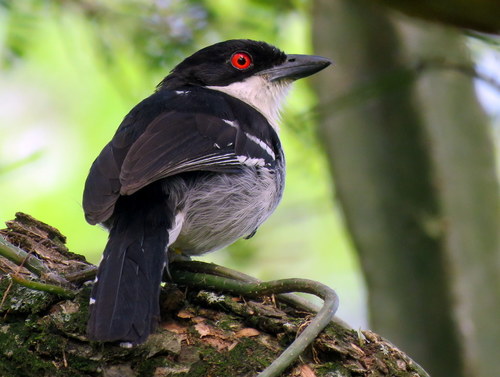
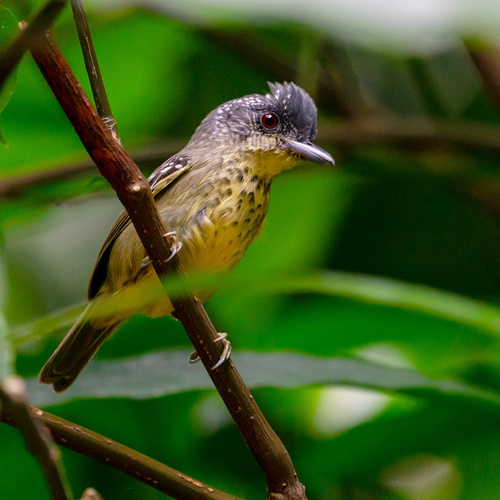
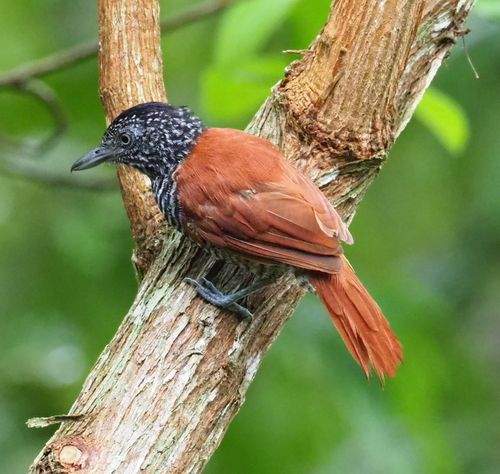
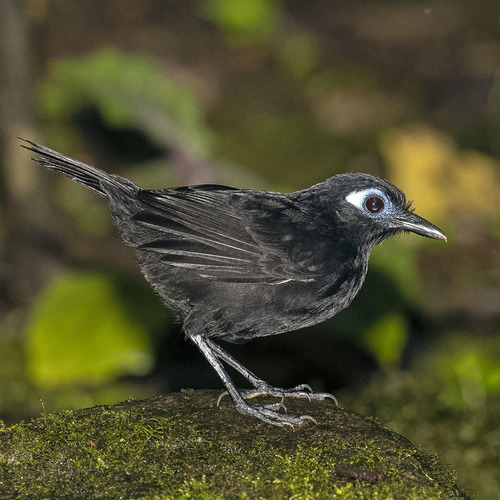
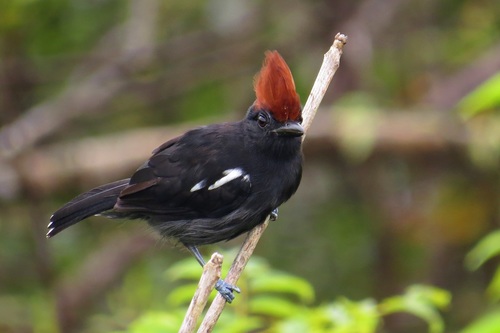
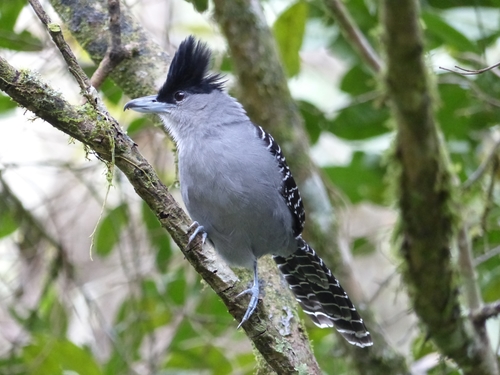
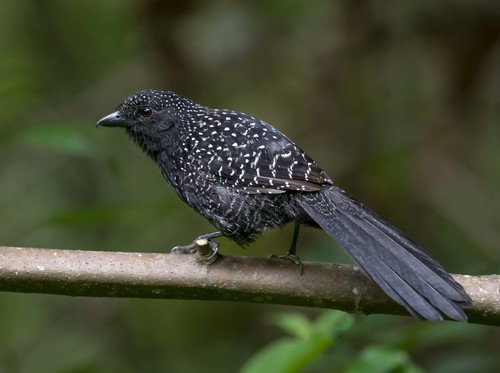
The large-tailed antshrike, with the scientific name Mackenziaena leachii (Such, 1825), is a large dark antbird that has a long full tail. It measures 25 to 26 cm (9.8 to 10 inches) in length and weighs 58 to 62 g (2.0 to 2.2 ounces). The species shows significant sexual dimorphism, but both sexes share a moderately long black bill that has a hook at the end, similar to the bills of true shrikes. Adult males are mostly black, with small white spots on their crown, nape, upperparts, and sides. Adult females are mostly brownish black; they have a rufous forehead, a rufous crown with black feather edges, pale buff spots on their upperparts, and pale buff bars on their wings. Their underparts are thickly spotted with buffy white, and their crissum is barred with buffy white. Subadults look similar to adult females, but have larger spots, and faint pale bars on their belly and tail.
For a long time, the large-tailed antshrike was thought to range from eastern Minas Gerais and southern Espírito Santo in Brazil, south through eastern Paraguay, to Misiones Province in northeast Argentina. However, a 2012 publication documented a new record in northeastern Uruguay, and this record was accepted by the South American Classification Committee of the American Ornithological Society. The large-tailed antshrike is native to the Atlantic Forest, and lives in the dense understorey of several different forest types. In the more northerly part of its range, it occurs in humid foothill and montane forest, especially in areas with large bamboo stands. Further south, it prefers somewhat degraded forest, including scrub with abundant bamboo, dry forest, humid and stunted foothill woodlands, and thickets at the edge of taller forest. In terms of elevation, its range extends from sea level to about 2,200 m (7,200 ft), and it tends to occur at higher elevations in the northern portion of its range.