About Machaeropterus striolatus (Hahn, 1819)
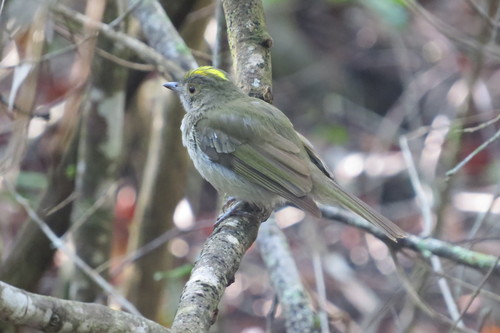
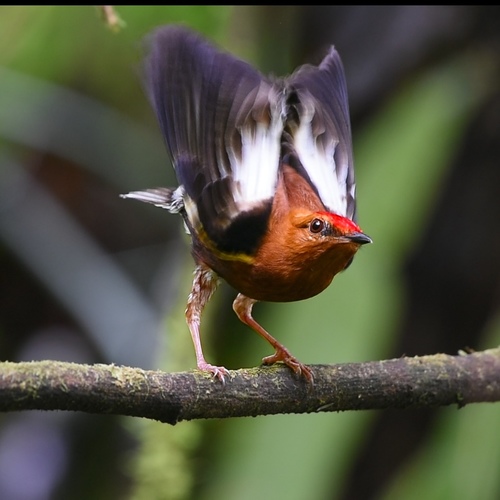
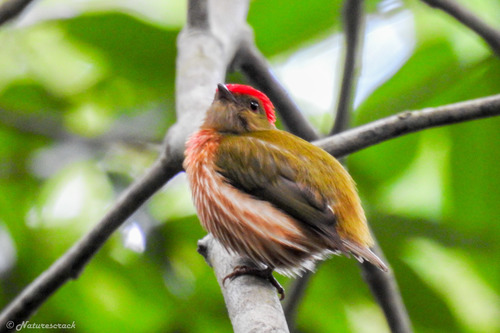
Machaeropterus striolatus (Hahn, 1819), commonly known as the striolated manakin, measures 9 to 10.3 cm (3.5 to 4.1 in) long and weighs 6.4 to 12.5 g (0.23 to 0.44 oz). The species is sexually dimorphic. Adult males of the nominate subspecies M. s. striolatus have bright red coloring on the forehead, crown, and nape. Their face, upperparts, and tail are bright olive-green. Their wings are mostly a grayer olive-green than the upperparts, with white tips on the tertials and white inner webs on the other flight feathers. Their chin and throat are buff or whitish, while the rest of their underparts are whitish with bold red stripes across the breast, belly, and flanks. Adult females have no red on their head; their upper breast has a yellow stain, and underpart streaks only appear on the belly and flanks. Both sexes have a deep red-brown iris, a dark horn to blackish upper mandible (maxilla), a paler lower mandible (mandible) with a dark tip, and purplish pink legs and feet with rose-colored soles. Four other recognized subspecies differ from the nominate subspecies and from each other as follows. M. s. antioquiae: Males have a darker red crown and more yellowish green upperparts than the nominate, with white streaks on the throat; females are essentially identical to nominate M. s. striolatus. M. s. obscurostriatus: Males have reddish streaks on the upper breast that become rufous on the lower breast, and an orange-yellow iris; females have a dull olive throat and upper breast; both sexes have a brown bill and grayish olive-green legs and feet. M. s. zulianus: Males have a red breast with dark chestnut streaks; females have whitish underparts with weak chestnut streaks; both sexes have an orange iris. M. s. aureopectus: Males have an orange wash on the uppertail coverts, black centers on the underpart streaks, and a yellow-stained chest; females have more whitish underparts than the nominate, with faint yellow on the breast; both sexes have a red iris. Each subspecies has a distinct range in South America. M. s. antioquiae is found in Colombia's Caribbean region and the valleys of the Cauca and Magdalena rivers. M. s. striolatus ranges across the eastern third of Colombia, south through eastern Ecuador into Peru as far as northern Ucayali, and east into Brazil's Acre, central Amazonas, and northwestern Rondônia. M. s. obscurostriatus occurs in Venezuela on the west side of the Andes from Mérida north into Trujillo. M. s. zulianus is found in Venezuela on the east side of Serranía del Perijá, the southern Maracaibo Basin, Zulia, and the east side of the Andes from northwestern Barinas north to southeastern Táchira. M. s. aureopectus ranges across southeastern Venezuela in central Amazonas and northwestern to southeastern Bolívar, extending east into western Guyana and far northern Roraima in Brazil. The striolated manakin primarily inhabits humid terra firme forest, occurs to a lesser extent in mature secondary forest, and is sometimes found at forest edges that host fruiting trees. Its elevation range varies by country: it reaches 1,500 m (4,900 ft) in Colombia; it is mostly found below 700 m (2,300 ft) in Ecuador but reaches 1,100 m (3,600 ft) in southern Ecuador; it occurs between 1,000 and 1,350 m (3,300 and 4,400 ft) in Peru; and it is mostly found between 300 and 1,200 m (1,000 and 3,900 ft) in Venezuela.