About Machaerirhynchus flaviventer Gould, 1851
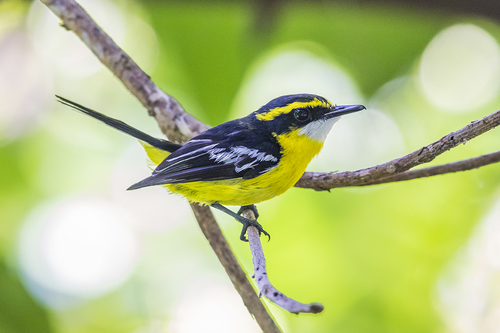
The yellow-breasted boatbill, scientifically named Machaerirhynchus flaviventer Gould, 1851, is a small distinctive bird, measuring 11 cm to 12.5 cm in length and weighing an average of 9 to 10 grams. Its black bill is large, wide, long, and flat relative to its body, shaped like a boat, which gives the species its common name. The tip of the beak is hooked, a shape shared with other species in the Machaerirhynchidae family. The bird also has a distinctive keel that marks its underside, which is a bright yellow that extends up the body to the breast, a trait that also contributes to its common name. The area under its beak, covering the neck region, is white. It has large round eyes with solid black pupils, and a yellow stripe across its forehead that sits where eyebrows would be. Males have solid black upperparts, while females have lighter olive upperparts; there are few other notable differences between the sexes. White stripes called wing bars run across the base of the wings. Relative to its small body, the yellow-breasted boatbill has a long black tail with a rounded end; recorded observations note the tail is often stiff and points upwards. It has average-sized legs, with small talons on a four-toed foot that includes the rear metatarsals. This species lives in tropical areas of the southern hemisphere. It occurs across the whole island of New Guinea, but is not endemic to any single country or island there. It also inhabits Cape York Peninsula in North Queensland, Australia, and has been sighted on several western offshore islands in the Oceania region, giving the species a very large range. Population densities are higher in North Queensland rainforests than across New Guinea. Across its entire range, the yellow-breasted boatbill is most commonly found in rainforests: dense vegetation ecosystems dominated by evergreen trees and shrubbery, with high annual rainfall that supports abundant plant growth. Rainforests provide good habitat for this bird because the dense vegetation and frequent rainfall attract large numbers of insects, which the species preys on. The yellow-breasted boatbill prefers to nest and live high in the rainforest canopy, where it is mostly safe from predators and immediate danger, and only leaves the canopy to forage for food. It can also be found in gallery forests, which have frequent rivers and ponds that support high abundance and diversity of vegetation. In gallery forests, the bird can nest safely in shrubbery near riverbanks, where there are also plenty of airborne insects to prey on. Beyond rainforests and gallery forests, the yellow-breasted boatbill has also been recorded living in forest edges and lowland ecosystems, for similar reasons to its preferred habitats.

