About Machaerina rubiginosa (Biehler) T.Koyama
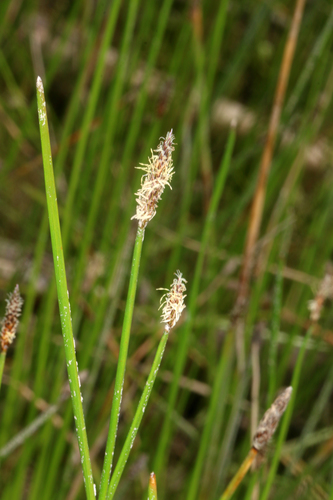
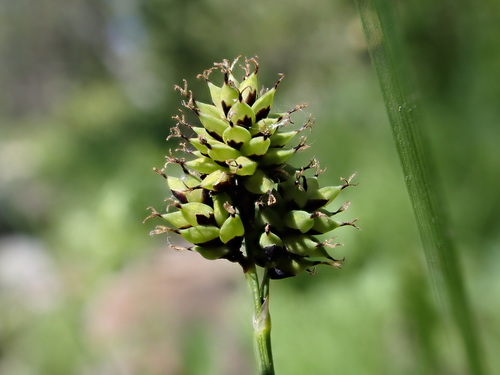
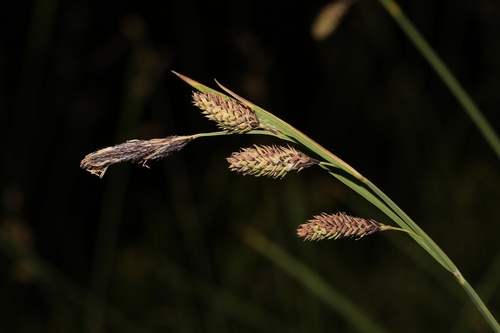
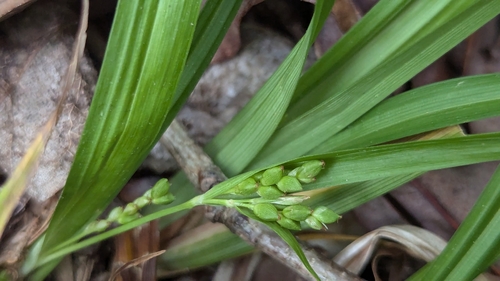
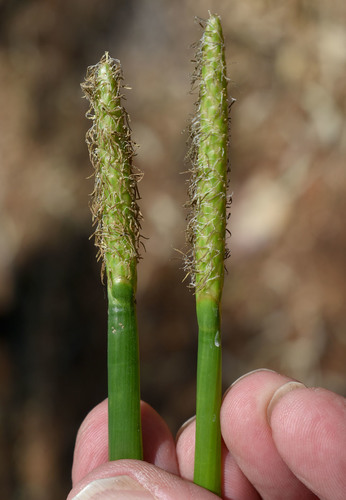
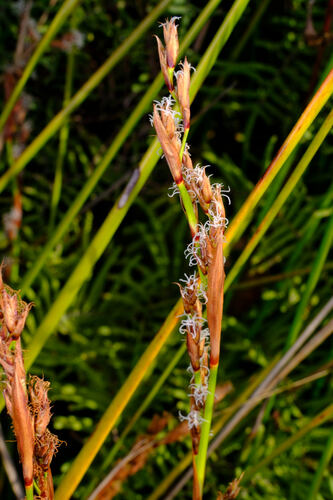
Machaerina rubiginosa (Biehler) T.Koyama is a robust, perennial, grass-like rhizomatous sedge. It typically reaches 4 metres (13.1 ft) in height and 2 metres (6.6 ft) in width. It blooms between August and March, producing brown flowers. Its culms are rigid, terete, biconvex, smooth, and glabrous. Culms measure 20 to 110 centimetres (0.7 to 3.6 ft) in length, and 1 to 5 millimetres (0.04 to 0.20 in) in diameter. Its narrow, erect inflorescence has an interrupted-oblong overall shape, forming dense clusters that are approximately 7 to 20 cm (2.8 to 7.9 in) long, with a diameter of 1 to 2.5 cm (0.39 to 0.98 in). After flowering, the plant produces an ellipsoid to obovoid nut, which ranges in color from pale red-brown to bright orange. The nut is smooth, with a hispid apex, and measures 2.2 to 4 mm (0.09 to 0.16 in) in length, and 1.2 to 2 mm (0.05 to 0.08 in) in diameter. This sedge grows in swamps and on the margins of lakes and streams in coastal areas, found within the Mid West, Wheatbelt, Peel, South West, Great Southern and Goldfields-Esperance regions of Western Australia, and also occurs in Queensland, Victoria, New South Wales, South Australia, Tasmania, and the Northern Territory. It grows in damp silty-sandy soils. Its upright foliage and spreading rhizomatous growth habit allow it to form large dense swards in wet areas. It can grow in nutrient-poor soils in water up to around 50 centimetres (1.6 ft) deep. Plants grow taller in permanently damp areas, and shorter in ephemeral environments. It is suitable for use in artificial wetlands.