About Maccullochella peelii (Mitchell, 1838)
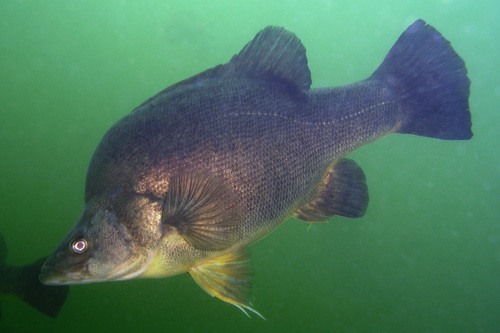
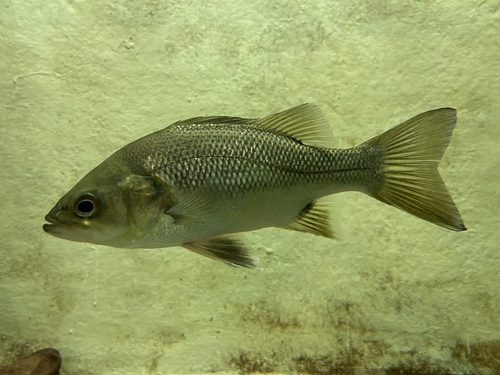
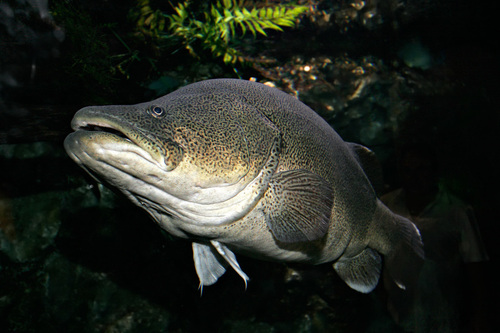
Murray cod (Maccullochella peelii (Mitchell, 1838)) is a large grouper-like fish with a deep, elongated body that is round in cross section. It has a broad, scooped head, and a large mouth lined with pads of very small, needle-like teeth. The jaws of Murray cod are equal, or the lower jaw protrudes slightly. The spiny dorsal fin is moderate to low in height and is partially separated by a notch from the high, rounded soft dorsal fin. Soft dorsal, anal, and caudal (tail) fins are all large and rounded, and are dusky grey or black with distinct white edges. The large, rounded pectoral fins are usually similar in colour to the flanks. The pelvic fins are large, angular, and set forward of the pectoral fins. The leading white-coloured rays on the pelvic fins split into two trailing white filaments, while the pelvic fins themselves are usually a translucent white or cream, becoming more opaque in large fish. Murray cod are white to cream on their ventral (belly) surfaces. Their backs and flanks are usually yellowish-green to green, covered with heavy darker green (and occasionally brown or black) mottling. This creates a marbled appearance sometimes reminiscent of a leopard's markings. Colouration varies with water clarity: it is intense in fish from clear water habitats. Small to medium-sized Murray cod from clear-water habitats often have striking and very distinct colouration, while very large fish tend towards a speckled grey-green colouration. Murray cod is named after the Murray River, which is part of the Murray-Darling basin in eastern Australia — Australia's largest and most important river system, draining around 14% of the continent. The Murray cod's natural range covers almost the entire Murray-Darling basin, particularly lowland areas, and extends well into upland areas: reaching an elevation of about 700 m (2,300 ft) in the southern half of the basin, and about 1,000 m (3,300 ft) in the northern half. As a result, Murray cod inhabit a remarkably wide variety of habitats, from cool, clear, fast-flowing streams with riffle-and-pool structure and rocky substrates in upland areas, to large, slow flowing, meandering rivers in the extensive alluvial lowland reaches of the Murray-Darling basin. Murray cod have died out in many of their upland habitats, particularly in the southern Murray-Darling basin, due to a combination of overfishing, siltation, dams and weirs blocking migration, pollution from arsenic-based sheep-dips, mining, and in some cases, introduced trout stockings that cause competition between juvenile Murray cod and introduced trout. Murray cod have also been introduced into other drainage basins, such as the Cooper Basin in Queensland. Over the past 150 years, hundreds of thousands, possibly more than a million, submerged timber "snags" (mainly River Red Gum) have been removed from lowland reaches of the Murray-Darling basin. Removing such a vast number of snags has had devastating impacts on Murray cod and river ecosystems. Snags are critical habitats and spawning sites for Murray cod. They are also critical to the functioning of lowland river ecosystems: as one of the few hard substrates in lowland river channels composed of fine silts, snags are crucial sites for biofilm growth, macroinvertebrate grazing, and general in-stream productivity. Vegetation clearing and cattle trampling of river banks create severe siltation, which fills in pools, degrades river ecosystems, and makes rivers and streams uninhabitable for Murray cod. This issue is made worse by the removal of riparian (riverbank) vegetation, which causes additional siltation and degrades river ecosystems in many ways. Murray cod reach sexual maturity between four and six years of age, most commonly five years. Sexual maturity depends on age. Roughly 70% of wild river Murray cod, which have slower growth rates, reach sexual maturity by 50 cm (20 in) in length. Wild Murray cod in impoundments like Lake Mulwala, which have faster growth rates, do not reach sexual maturity until they are well over 60 cm (2.0 ft) in length. These data strongly indicate the 50-cm (20-in) size limit for Murray cod is inadequate and should be increased substantially to give individuals a greater chance of reproducing before being caught. Large female Murray cod in the 15– to 35-kg (35– to 80-lb) range are the most important breeders, because they produce the most eggs. Large females of most fish species are also important because they produce larger larvae with larger yolk sacs, are more experienced breeders that display optimal breeding behaviours, and may carry valuable, successful genes to pass on. All of these factors mean spawnings from large female fish have far higher larval survival rates and make far greater reproductive contributions than spawnings from small female fish. Contrary to a claim from some recreational fishers that "large Murray cod don't breed", this claim is entirely untrue. When female Murray cod first reach sexual maturity, their egg counts are no more than 10,000. Very large female Murray cod can have egg counts as high as 80,000–90,000; one recent very large 33-kg specimen had an egg count of 110,000 viable eggs. Egg counts for female Murray cod of all sizes are relatively low compared to many fish species. Murray cod spawn in spring, triggered by rising water temperatures and increasing photoperiod (daylight length). Initially, fish biologists studying Murray cod considered spring floods and temperatures of 20–21 °C (68–70 °F) to be necessary for spawning, and believed spring flooding is critical for successful recruitment (survival to juvenile stages) of young cod by bringing pelagic zooplankton and early life-stage macroinvertebrates from the flood plain into the main river channel for first feeding. However, more recent research has shown Murray cod breed annually, with or without spring floods, and at temperatures as low as 15 °C (59 °F). Additionally, recent research has found abundant epibenthic/epiphytic (bottom dwelling/edge clinging) prey in unflooded lowland rivers, that Murray cod larvae have traits that allow survival in a variety of challenging conditions, and that a significant proportion of Murray cod larvae feed successfully in unflooded rivers. The latest research has also shown that Murray cod live their entire lifecycle within the main channel of the stream. Earlier ideas that Murray cod spawn on floodplains, or that their larvae feed on floodplains, are incorrect. Murray cod breed in the main river channel or, during spring floods, the inundated upper portion of the main channel and tributary channels, but not on floodplains. Murray cod larvae feed within the main river channel or, during spring floods, on the inundated upper portion of the main channel and the channel/floodplain boundary, but not on the floodplain. Spawning is sometimes preceded by upstream or downstream movements. Radio-tracked Murray cod in the Murray River have moved up to 120 km (75 mi) upstream to spawn, before returning to exactly the same snag they departed from, an unusual homing behaviour for a freshwater fish. Decades of observations by recreational and commercial fishermen suggest such spring spawning movements are common across Murray cod's entire geographical range. Spawning is initiated by pairing up and courtship rituals. During the courtship ritual, a spawning site is selected and cleaned: hard surfaces such as rocks in upland rivers and impoundments, and logs and occasionally clay banks in lowland rivers, at a depth of 2–3 metres (6.6–9.8 ft), are selected. The female lays the large adhesive eggs as a mat on the spawning surface, which the male fertilises. The female then leaves the spawning site. The male remains to guard the eggs during incubation, which takes six to 10 days depending on water temperature, and then guards the hatched larvae for a further week or so until they disperse. Larvae disperse from the nest site by drifting in river currents at night, and continue this behaviour for around four to seven days. During this dispersal process, larvae simultaneously absorb the remainder of their yolk sac and begin to feed on small, early life-stage macroinvertebrates and epibenthic/epiphytic (bottom dwelling/edge clinging) microinvertebrates. Murray cod may be the first freshwater fish identified as having long-term pair-bonding as a mating strategy in the wild. The relationship between river flows and Murray cod recruitment is more complex than originally thought, and in less regulated rivers, Murray cod may be able to recruit under a range of conditions including stable low flows (significant recruitment of Murray cod in low-flow conditions in less regulated lowland rivers has now been proven). This information also suggests that non-river-regulation-related causes of degradation are playing a larger role in the survival and recruitment of Murray cod larvae than initially thought. Competition from extremely large numbers of invasive carp larvae negatively affects the survival and recruitment of Murray cod larvae to a much greater degree than first thought, and decades of overfishing plays a far larger role in the current state of Murray cod stocks (through depletion of spawning adults) than first thought. These findings do not mean that river regulation and water extraction have not had adverse effects on fish stocks. Rather, river regulation has been a major factor in the decline of Murray cod and other native fish. Thermal pollution is also a major problem. Evidence indicates strong Murray cod recruitment events (which may be important for sustaining Murray cod populations over the long term) can result from spring flooding, and the health of Australian lowland river ecosystems generally relies on periodic spring flooding. Due to regulation of most rivers in the Murray-Darling River system, mainly for irrigation purposes, only exceptional spring floods manage to occur. There is great concern over the long-term viability of wild Murray cod, other native fish species, and river ecosystems given this situation.