About Macarostola miniella (Felder & Rogenhofer, 1875)
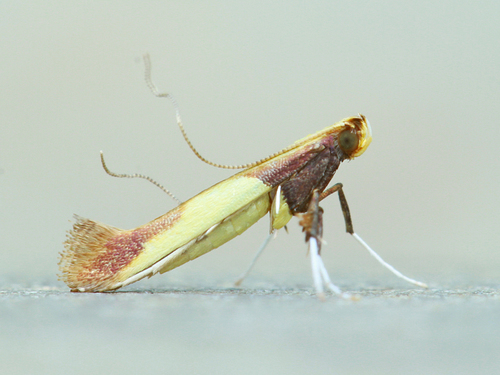
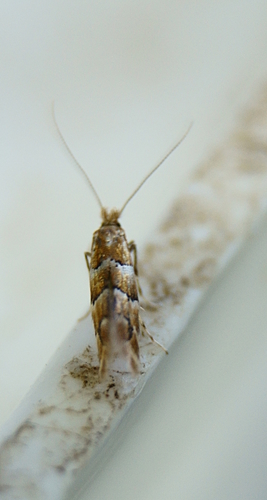
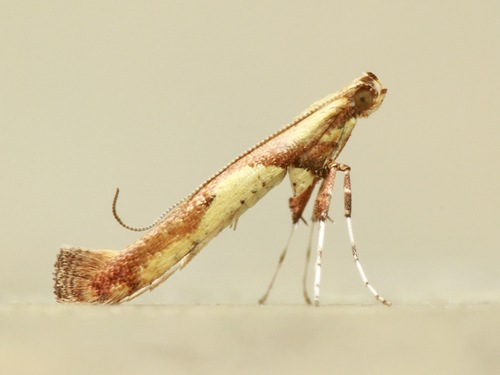
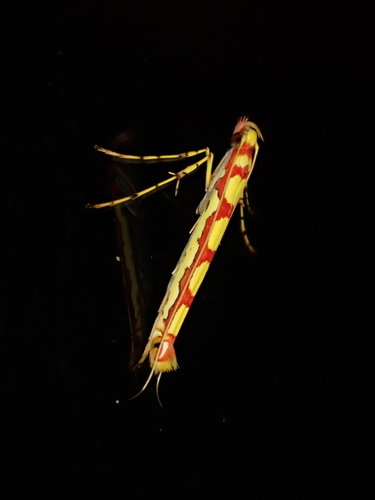
Meyrick gave the following description of this species: Both males and females have a body length between 11 and 13 mm. The crown of the head is yellow, the back of the head is crimson, and the face is snow-white with two pale crimson spots. The palpi are white, and the second joint is crimson. The thorax is yellow, with a crimson anterior margin and a crimson spot on its posterior section. The forewings are pale yellow, with deeper yellow colouring towards the inner margin. A bright crimson undulating central streak runs from the base to the apex; this streak is sometimes margined with dark fuscous along its upper edge, connects to the inner margin via perpendicular bars near the base, and at the 1/4, 1/2, and 3/4 positions along the wing, and connects to the costa at and near the base. The forewings have a round crimson apical spot that contains a blackish spot towards the costa, plus a white triangular spot on the inner margin. The cilia are yellow around the apex, with a dark fuscous hook, crimson below the apical spot, and very pale crimson beyond this section. The hindwings are light crimson, and their cilia are very pale crimson, turning grey on the costa. Adult moths of this species have two distinct colour variations. The more common variation has the crimson and yellow colouring described above. In the rarer variation, dull fuscous colour replaces the crimson found in the common form. This species is endemic to New Zealand. It is common and found across the entire North Island. This species occurs in native forest habitats. Its larvae are leaf miners that feed on Syzygium maire, a tree species also endemic to New Zealand.