About Macaca sylvanus (Linnaeus, 1758)
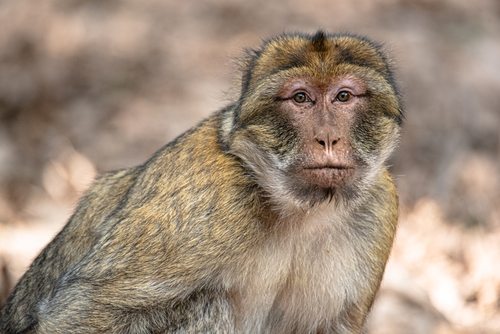
The Barbary macaque (Macaca sylvanus) has a dark pink face, with pelage ranging from pale buff to golden brown to grey, and a lighter underside. The fur color of mature individuals changes with age. In adults and subadults, individual hairs have banding that creates a variegated pattern of pale and dark across the back. When temperatures rise from spring to early summer, adult Barbary macaques moult their thick winter fur. The species displays sexual dimorphism, with males being larger than females. The average head-body length is 55.7 cm (21.9 in) for females and 63.4 cm (25.0 in) for males. Its vestigial, boneless tail is greatly reduced compared to other macaque species; when present, it measures 4–22 mm (0.16–0.87 in). Limited data suggests males may have a more prominent tail. Average body weight is 9.9–11 kg (22–24 lb) for females and 14.5–16 kg (32–35 lb) for males. Like all Old World monkeys, the Barbary macaque has well-developed ischial callosities, or sitting pads, on its rear. Females have an exaggerated anogenital swelling that increases in size during oestrus. This species has cheek pouches and high-crowned bilophodont molars, which are molars with two ridges, and its third molar is elongated. The diploid chromosome number of the Barbary macaque is 42, which matches other members of the Old World monkey tribe Papionini.
Historically, the Barbary macaque ranged across North Africa from Libya to Morocco. It is the only primate that survives north of the Sahara Desert in Africa. Today, it lives mainly in fragmented areas of the Rif, Middle Atlas, and High Atlas mountain ranges in Morocco, and the Grande and Petite Kabylie mountain region in Algeria. It has been recorded at elevations between 400–2,300 m (1,300–7,500 ft), and appears to prefer higher elevations. The Moroccan and Algerian populations are separated by around 700 km (430 mi); this gap was smaller during the Holocene. A population of Barbary macaques also lives in Gibraltar, a British Overseas Territory at the southern tip of Europe's Iberian Peninsula. Gibraltar historian Alonso Hernández del Portillo recorded in the early 17th century that the macaques had been present "from time immemorial". It is most likely that Moors introduced Barbary macaques from North Africa to Gibraltar during the Middle Ages. During World War II, Winston Churchill ordered additional macaques to be introduced to Gibraltar to reverse population declines. Today, there are around 300 Barbary macaques living in Gibraltar. The species can live in a variety of habitats, including cedar, fir, and oak forests, grasslands, thermophilous scrub, and vegetated rocky ridges, all in Mediterranean climates with seasonal temperature extremes. In Morocco, most Barbary macaques inhabit Atlas cedar (Cedrus atlantica) forests, though this may reflect current habitat availability rather than a specific preference for this habitat. In Algeria, the Barbary macaque mainly inhabits the Grande and Petite Kabylie ranges, part of the Tell Atlas mountain chain, with an additional isolated population in Chréa National Park. It lives in mixed cedar and holm oak forests, humid Portuguese and cork oak forests, and scrub-covered gorges. Fossil evidence shows that the Barbary macaque lived in southern Europe during the Pleistocene, and also lived in England during interglacial periods. Ancient Greek writer Herodotus mentioned a population of Barbary macaques in Tunisia, which means the species went extinct there within the last 2,500 years.
The Barbary macaque is gregarious, forming mixed groups that include multiple females and males. Troops can contain 10 to 100 individuals, and are matriarchal, with social hierarchy determined by lineage to the lead female. Unlike other macaque species, males participate in rearing young. Males may spend a large amount of time playing with and grooming infants, forming strong social bonds between males and juveniles that includes both the male's own offspring and other troop members' young. This pattern may arise because females prefer highly parental males. The mating season runs from November through March. The gestation period lasts 147 to 192 days, and females typically produce only one offspring per pregnancy. Females only give birth to twins in rare instances. Offspring reach maturity at three to four years of age, and can live for 20 years or more. Grooming other Barbary macaques lowers stress levels for the individual doing the grooming. While stress levels do not appear to decrease for the individual being groomed, grooming a higher number of individuals leads to even lower stress for the groomer. This benefit may outweigh the costs of grooming, which include less time for other activities like foraging. The stress-reducing effect is likely tied to the social relationships and support built through grooming. Male Barbary macaques interfere in conflicts and form coalitions with other males, usually teaming up with related males rather than unrelated ones. These relationships suggest males form coalitions to indirectly increase their own fitness. Males also form coalitions with close kin more often than with distantly related kin. These coalitions are not permanent, and change frequently as male social ranking within the group shifts. While males are more likely to form coalitions with males that have helped them in the past, relatedness is a more important factor in determining coalition partnerships than past help. Males avoid conflict with higher ranking males, and more often form coalitions with the higher ranking male involved in a conflict. Close grouping of males occurs when infant Barbary macaques are present. Interactions between males are commonly initiated when a male presents an infant to an adult male that is not caring for an infant, or when an unattached male approaches males caring for infants. This behavior creates social buffering that reduces the number of antagonistic interactions between males in a group. An open mouth display is most commonly used by juvenile macaques as a sign of playfulness.
Many of the incorrect ideas about human anatomy found in Galen's writings are thought to come from his use of Barbary macaques for dissections, as this was the only anthropoid available to him. Strong cultural taboos of Galen's time prevented him from dissecting human cadavers, even in his role as a physician and teacher of physicians. In Morocco, Barbary macaques are frequently used as photo props despite their protected status. Tourists pay fees to have photos taken with the animals. Macaques are also sold as pets in Morocco and Algeria, and exported to Europe to be kept as pets or used as fighting monkeys, both in physical markets and online. Tourists interact with wild monkeys around the world, and in some cases are encouraged to feed, photograph, and touch the monkeys. While tourism can generate funding for conservation and create an incentive to protect natural habitats, close proximity and interactions with tourists have significant negative psychological impacts on Barbary macaques. Tests of fecal samples and observations of stress-indicating behaviors like belly scratching confirm that the presence of tourists negatively affects the macaques. Human activities such as photography cause the animals stress, possibly because people come too close and make prolonged eye contact, which is a signal of aggression in many primates. Barbary macaques living in areas with frequent human contact have more parasites and lower overall health than those in less disturbed wild environments, in part due to unhealthy diets from eating food provided by humans. Several groups of Barbary macaques live in tourist sites, where they are impacted by visitors giving them food. A 2008 study comparing two such groups in the central High Atlas mountains found that the tourist-site group spent significantly more time resting and engaging in aggressive behavior, and spent significantly less time foraging and moving, than the wild group. The tourist-site group also spent significantly less daily feeding time on herbs, seeds, and acorns than the wild group. Human food made up 26% of the daily feeding records for the tourist-site group, compared to just 1% for the wild-feeding group. Research on seasonal activity budgets and diet composition of an endangered Barbary macaque group at a Moroccan tourist site found that the group's activity budgets and diet varied noticeably between seasons and habitats. The percentage of daily time spent foraging and moving was lowest in spring, while daily time spent resting was highest in spring and summer. The time budget dedicated to aggressive displays was higher in spring than in the other three seasons. Consumption of flowers and fruits increased in summer, consumption of seeds, acorns, roots, and bark increased in winter and autumn, consumption of herbs was highest in spring and summer, and consumption of human food showed a clear increase in spring. The tourist-site and wild groups did not differ in the proportion of daily records devoted to terrestrial feeding. However, the tourist-site group spent a significantly lower percentage of daily records on terrestrial foraging, moving, and resting, and performed more terrestrial aggressive displays than the wild group. There was no significant difference between the two groups in the proportion of terrestrial feeding records spent eating fruits, but the tourist group had lower daily percentages of terrestrial feeding on leaves, seeds and acorns, roots and barks, and herbs, while it had higher daily percentages of terrestrial feeding on human food. Archaeological evidence shows that Barbary macaques were traded or possibly given as diplomatic gifts as early as the Iron Age. Remains indicating this have been found at sites including Emain Macha in Ireland (dating to no later than 95 BC), the Iron Age hillfort of Titelberg in Luxembourg, and two Roman sites in Britain.