About Macaca nemestrina (Linnaeus, 1766)
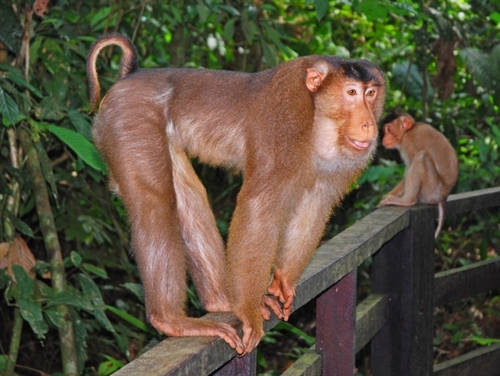
Like other species in the Macaca genus, male Macaca nemestrina are larger than females. Males measure 50–58 cm (20–23 in) in length and weigh 5–12 kg (11–26 lb), while females measure 38–48 cm (15–19 in) in length and weigh 4.5–6 kg (9.9–13.2 lb). This macaque has buff-brown fur, with a darker dorsal region and lighter ventral region. Its common name comes from its short semi-erect tail, which resembles a pig’s tail. This macaque mostly inhabits rainforests up to 2,000 metres (6,600 ft) in elevation, and it will also enter plantations and gardens. Its range covers the southern half of the Malay Peninsula (only just extending into southernmost Thailand), Borneo, Sumatra, and Bangka Island. There are reports that this species was present in Singapore before 1950, but these individuals were likely escaped pets. All pig-tailed macaques currently in Singapore are introduced individuals. M. nemestrina is primarily terrestrial, but it is also a skilled climber. Unlike almost all primates, these macaques enjoy water. They live in large social groups that split into smaller groups during daytime foraging. They are omnivorous, and their diet consists mainly of fruits, seeds, berries, cereals, fungi, and invertebrates. A study conducted in peninsular Malaysia found that this species is the primary, and possibly the only, seed disperser for the rattan species Calamus calicarpus (syn. Daemonorops calicarpa) and Calamus castaneus. This species has social hierarchies: male hierarchy is based on strength, while female hierarchy is based on heredity. Because of this hereditary hierarchy, the daughter of the alpha female ranks immediately above all other females in the group. The alpha female leads the group, while males primarily manage internal group conflict and defend the group. Female gestation lasts approximately 5.7 months. Females give birth to a single infant every two years. Young are weaned at 4–5 months of age, and reach sexual maturity at 3–5 years of age. In Thailand, people have trained this species to harvest coconuts for 400 years.