About Macaca mulatta (Zimmermann, 1780)
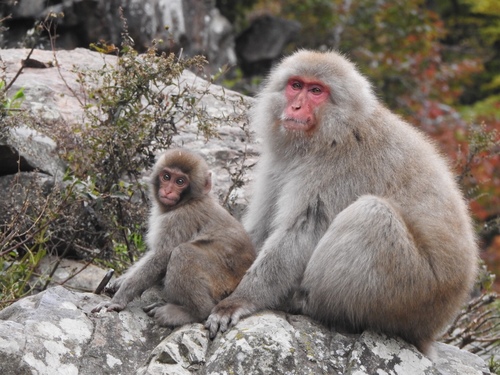
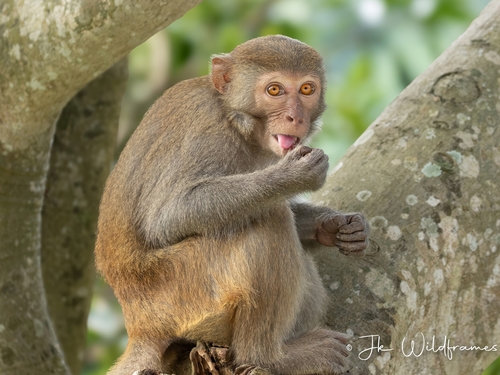
The rhesus macaque (Macaca mulatta) is brown or grey with a hairless pink face. On average, it has 50 vertebrae and a wide rib cage. Its tail measures an average of 20.7 to 22.9 cm (8.1 to 9.0 in) in length. Average adult males are about 53 cm (21 in) long and weigh about 7.7 kg (17 lb), while females are smaller, averaging 47 cm (19 in) in length and 5.3 kg (12 lb) in weight. The ratio of its arm length to leg length falls between 89.6 and 94.3%. It has a dental formula of 2.1.2.3/2.1.2.3, for a total of 32 teeth, and bilophodont molar teeth. Rhesus macaques are native to India, Bangladesh, Pakistan, Nepal, Myanmar, Thailand, Afghanistan, Vietnam, southern China, and some neighboring areas. They have the widest geographic range of any non-human primate, occupying a great diversity of altitudes across Central, South, and Southeast Asia. They inhabit arid, open areas, and can be found in grasslands, woodlands, and mountainous regions up to 2,500 m (8,200 ft) in elevation. They are strong swimmers capable of crossing rivers. They are well known for moving from rural to urban areas, where they come to rely on human handouts or refuse. They adapt very well to human presence, and form larger troops in human-dominated landscapes than in forests. They live in patches of forest within agricultural areas, which gives them access to agroecosystem habitats and lets them navigate these areas easily. In western India, the southern distribution limit of rhesus macaques and the northern distribution limit of bonnet macaques currently run parallel to each other. The limits are separated by a large gap in central India, and converge on the eastern coast of the Indian peninsula to form a zone of overlapping distribution. This overlap region is characterized by mixed-species troops, though pure troops of both species sometimes occur even when close to one another. Rhesus macaque range expansion is a natural process in some areas, and a direct result of human introduction in other regions. This expansion poses serious implications for the endemic, declining populations of bonnet macaques in southern India. A 2013 summary by Kumar et al. of population distribution and habitat in India states that rhesus macaques were sighted in all surveyed habitats except semi-evergreen forests. The rhesus macaque is diurnal, and is both arboreal and terrestrial. It moves quadrupedally, and when on the ground it walks with a digitigrade and plantigrade posture. It is mostly herbivorous, feeding mainly on fruit, and also consuming seeds, roots, buds, bark, and cereals. It is estimated to consume around 99 different plant species from 46 families. During the monsoon season, it gets most of its water from ripe and succulent fruit. Rhesus macaques living far from water sources lick dewdrops from leaves and drink rainwater that has collected in tree hollows. They have also been observed eating termites, grasshoppers, ants, and beetles, alongside other foods including adult and larval insects, spiders, lice, honeycombs, crabs, and bird eggs. When food is abundant, food resources are distributed in patches, and rhesus macaques forage throughout the day within their home ranges. They drink water while foraging, and gather around streams and rivers. Rhesus macaques have specialized pouch-like cheeks that let them temporarily store hoarded food. As human-caused land change has increased, the rhesus macaque has adapted alongside the intense and rapid environmental disturbance linked to human agriculture and urbanization, which has altered the proportions of items in its diet. In psychological research, rhesus macaques have shown a variety of complex cognitive abilities, including the ability to make same-different judgments, understand simple rules, and monitor their own mental states. They have even been observed to demonstrate self-agency, an important type of self-awareness. In 2014, onlookers at a train station in Kanpur, India documented a rhesus macaque that had been knocked unconscious by overhead power lines being revived by another rhesus macaque, which systematically carried out a series of resuscitative actions. Adult male rhesus macaques attempt to maximize their reproductive success by mating with females both inside and outside of the breeding period. Females prefer to mate with males that are not familiar to them, and prefer outsider males that are not part of the female’s own troop over higher-ranking males. Outside of the consortship period, males and females return to their prior behavior of not showing preferential treatment or any special relationship to one another. The breeding period can last up to eleven days, and a female usually mates with numerous males during this time. Male rhesus macaques have been observed fighting for access to sexually receptive females, and receive more wounds during the mating season. Female rhesus macaques first breed when they are four years old, and reach menopause around twenty-five years of age. Male macaques generally do not participate in raising young, but do have peaceful relationships with the offspring of their consort pairs. Manson and Parry found that free-ranging rhesus macaques avoid inbreeding; adult females were never observed copulating with males from their own matrilineage during their fertile periods. Mothers with one or more immature daughters in addition to their infants have less contact with their infants than mothers with no older immature daughters, because mothers may pass parenting responsibilities to their older daughters. High-ranking mothers with older immature daughters also reject their infants significantly more often than those without older daughters, and tend to begin mating earlier in the mating season than would be expected based on their previous parturition date. Infants that are farther from the center of the group are more vulnerable to infanticide from outside groups. Some mothers abuse their infants, which is thought to result from controlling parenting styles. Primatologist Robert Goy found that adult rhesus macaques will care for an unrelated infant when in captivity. A male rhesus macaque will ignore an infant as long as a female rhesus macaque is present. If a male rhesus macaque is the only available caregiver, he will care for an unrelated infant the same way a female would.