About Macaca leonina (Blyth, 1863)
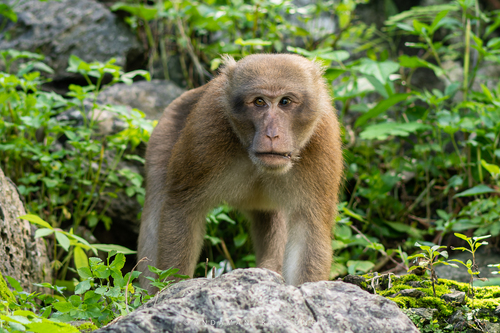
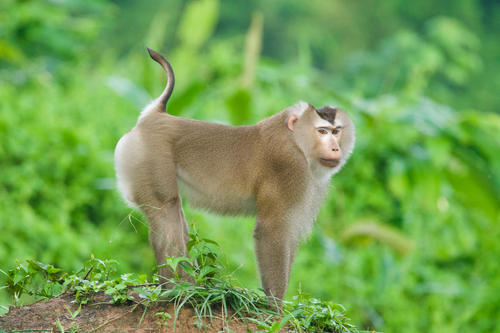
The northern pig-tailed macaque (Macaca leonina) is a vulnerable species of macaque in the family Cercopithecidae. It ranges across Bangladesh, Cambodia, China, India, Laos, Myanmar, Thailand, and Vietnam. Traditionally, M. leonina was classified as a subspecies of the southern pig-tailed macaque (M. nemestrina), but it is now recognized as a distinct species. In the 21st century, the original pig-tailed macaque grouping was split into the northern pig-tailed macaque M. leonina and the Sundaland pig-tailed macaque M. nemestrina. This reclassification was supported by observations of sexual swellings and other basic characteristics that distinguish the two species. Northern pig-tailed macaques are primarily frugivorous, and live in matriarchal social groups. Males and females can be told apart by their sexually dimorphic traits. When fruit is scarce, they adapt to an omnivorous diet, feeding on wild vegetation, crops, human foods, small insects, and small mammals. Despite this dietary adaptability, the species faces multiple threats. Viral threats include human immunodeficiency virus type 1, pathogenic simian immunodeficiency, and coronavirus. Human activities including agricultural expansion, aquaculture development, transportation infrastructure construction, hunting for meat and trophies, logging, and the illegal pet trade also harm the species, causing habitat loss, forest fragmentation, and reduced population well-being. Like all macaque species, northern pig-tailed macaques live in matriarchal social groups, so females hold dominance within the group. Mating takes place when females attract males with reddened swellings on their sexual skin. These swellings are triggered by hormone fluctuations during ovulation, the female's receptive period. Female swellings are a common indicator of fertility, and can persist beyond the periovulatory period. The receptive period is marked by consistent mating activity over several consecutive days, during which males may mate using either a single mount or multiple mounts. A visible sperm plug can also be observed after copulation during this period. Female pregnancy lasts more than eight months, and results in a single offspring. After birth, females lactate to nurse the newborn and infant until the offspring reaches two years of age.