About Lytta vesicatoria (Linnaeus, 1758)
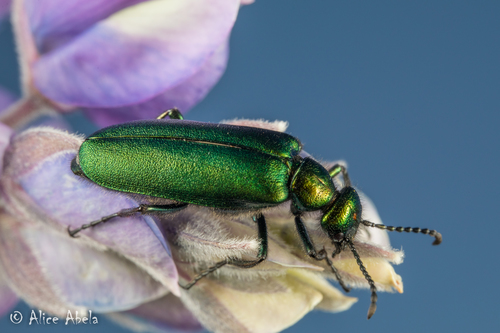
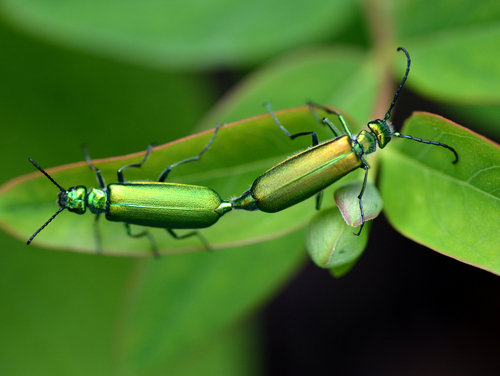
Lytta vesicatoria, commonly called the Spanish fly, is a species of blister beetle. Adult Spanish flies are slender, soft-bodied metallic insects with iridescent golden-green coloration. Adults measure approximately 5 mm (0.2 in) wide and 20 mm (0.8 in) long. After fertilization, females lay their eggs on the ground near the nests of ground-nesting solitary bees. Newly hatched larvae are immediately active: they climb onto flowering plants to wait for solitary bees, then attach themselves to a visiting bee using three claws on their legs. This first larval instar is named a triungulin, from the Latin words tri meaning three, and ungulus meaning claw. The bee carries the triungulin larvae back to its nest, where the larvae feed on the bee's own larvae and stored food supplies, placing them in a lifestyle between predation and parasitism. After this active first stage, larvae moult into a form that more closely matches typical scarabaeoid larvae for their remaining two or more instars, a developmental pattern called hypermetamorphosis. Once development is complete, adult beetles emerge from the bee nest and fly to woody plants to feed. This species is well known for the defensive toxic chemical cantharidin, which is only synthesised by males. Females gain cantharidin from males during mating, as it is included in the spermatophore. This is hypothesised to act as a nuptial gift that makes mating more valuable to females, increasing the male's reproductive fitness. Zoologists observe that the species' conspicuous coloration, potent defensive toxin, and adult aggregating behaviour in open view of predators strongly supports that these blister beetles exhibit aposematism.
Spanish fly ranges across Eurasia, and is primarily a species of southern Europe. There are confirmed records from southern Great Britain and Poland. Adult beetles feed most often on the leaves of ash, lilac, amur privet, honeysuckle, and white willow. They are occasionally found feeding on plum, rose, and elm.
Cantharidin from this species is dangerously toxic, and works by inhibiting the enzyme phosphatase 2A. It causes irritation, blistering, bleeding, and discomfort. These effects can progress to erosion and bleeding of the mucosa of every body system, sometimes leading to severe gastrointestinal bleeding, acute tubular necrosis, and glomerular destruction. This in turn can cause gastrointestinal and renal dysfunction, organ failure, and death. Preparations made from Spanish fly and its active cantharidin have been linked to both accidental and intentional poisonings. In 1954, Arthur Kendrick Ford was imprisoned after two women died unexpectedly from eating candy he had secretly laced with cantharidin, which he intended to act as an aphrodisiac. It has been suggested that George Washington was treated with Spanish fly for the epiglottitis that ultimately caused his death. In the United States today, cantharidin formulated as collodion is used to treat warts and molluscum.
In Morocco and other parts of North Africa, spice blends called ras el hanout sometimes included "green metallic beetles" as a minor ingredient; these are inferred to be L. vesicatoria. Sale of this ingredient in Moroccan spice markets was banned in the 1990s. Dawamesk, a North African spread or jam made with hashish, almond paste, pistachios, sugar, orange or tamarind peel, cloves, and other mixed spices, occasionally included cantharides.
In ancient China, these beetles were combined with human excrement, arsenic, and wolfsbane to create the world's first recorded stink bomb. In ancient Greece and Rome, Spanish fly was used in attempted treatments for skin diseases. In medieval Persia, Islamic medicine used Spanish fly (known locally as ḏarārīḥ, ذراریـح) in an attempt to prevent rabies. In the 19th century, Spanish fly was mainly used externally as a blistering agent and local irritant. It was also used in therapy for chronic gonorrhoea, paralysis, leprosy, and ulcers. L. vesicatoria was used internally as a diuretic stimulant, and an extract of the beetle was widely believed to be a powerful aphrodisiac, with many love potions named for it.