About Lythrurus fumeus (Evermann, 1892)
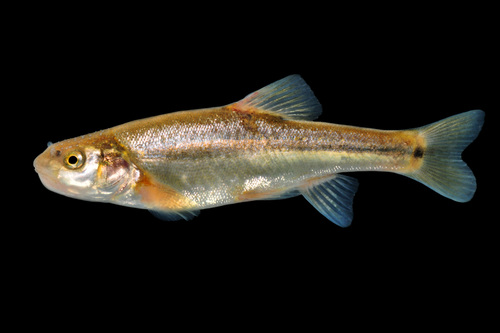
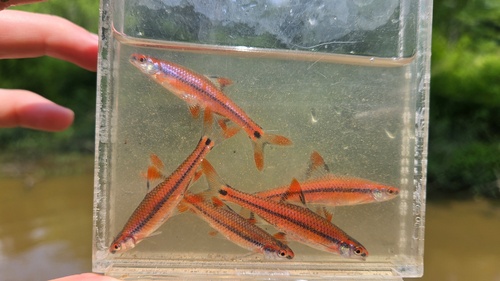
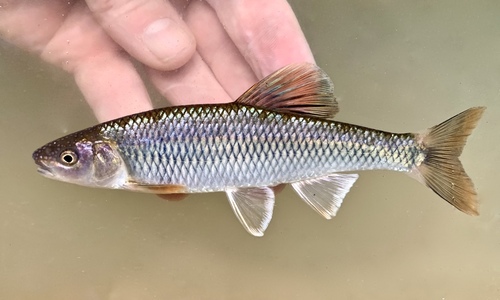
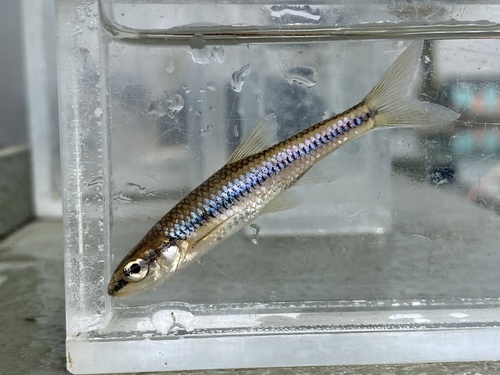
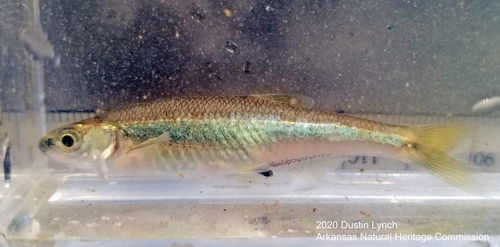
Lythrurus fumeus, commonly called the ribbon shiner, is a member of the family Cyprinidae. This species has a short, rounded snout, a relatively large terminal mouth, and a short head with large eyes; the eye diameter is greater than the snout length. Its body is moderately deep, elongated, and laterally compressed, and its dorsal fin has no prominent black spot. The dorsal surface of the body is typically olive or straw-colored with a silver overlay, and a dusky stripe runs along the back. The ventral surface is silvery white, with a silver-black stripe along the flank. This species has more than 21 predorsal scale rows, small scales, and 10–12 anal rays. It reaches a maximum total length of 55 mm (2.16 inches). Ribbon shiners are most commonly found in small to moderate-sized calm streams. These streams can be clear to cloudy, with a streambed composed of sand, mud, clay, silt, or detritus. The species is distributed in Gulf drainages from Lake Pontchartrain, Louisiana, to the Navidad River, Texas; it occurs in all Lake Pontchartrain drainage systems except the Tangipahoa. It is also native to the Mississippi River Basin, ranging from lower Mississippi drainages to Tennessee drainages, and found in Central Illinois, southwestern Indiana, eastern Oklahoma, western Kentucky, and northwestern Alabama. Most of its range falls below the Fall Line, but it extends above the Fall Line in the Arkansas River drainage. Ribbon shiners spawn in late spring or summer. Breeding males develop yellow breeding coloration, and there is no sexual dimorphism in adult body size. They are broadcast spawners. No information is currently available regarding the age at which individuals reach sexual maturation.