About Lysmata grabhami (Gordon, 1935)
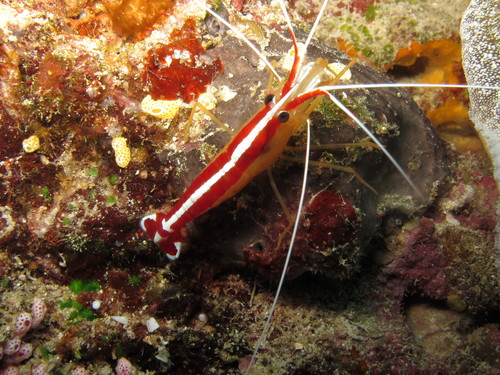
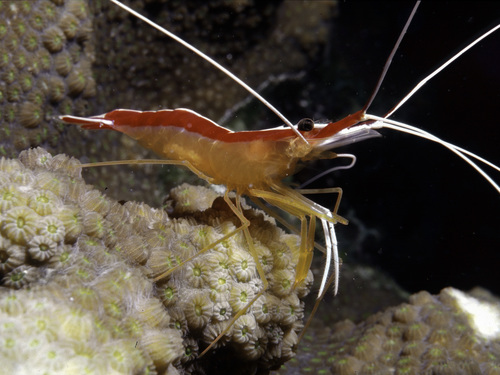
Lysmata grabhami can reach a total length of 6 centimeters (2.4 inches). It has a very distinctive appearance: its antennae and third pair of maxillipeds are both white, its body is yellow, and it bears a continuous white dorsal stripe that runs from its head all the way to its telson. This white stripe is bordered by a longitudinal red stripe on each side. Its legs are yellow, and the external branches of its uropods have a white stripe along the outer edge. This species lives in shallow water across both sides of the tropical and subtropical Atlantic Ocean, and is most commonly found in reef environments. In the western Atlantic, it occurs along the coast of North America, in the Caribbean Sea and Gulf of Mexico, and around Bermuda. In the eastern Atlantic, it can be found near the Canary Islands, Madeira, and Cape Verde. Lysmata grabhami is a cleaner shrimp. Like some other shrimp species and some small fish, it maintains cleaning stations that larger fish visit to have external parasites removed. The shrimp waves its long white antennae to attract client fish. When a client fish poses by extending a fin or opening its mouth, the shrimp moves onto the fish’s body and picks off parasites until the fish leaves. An individual shrimp may stay at one cleaning station for a long time. Common client fish of this shrimp include groupers, parrotfishes, and tangs. This relationship is symbiotic: the client fish gets rid of harmful parasites, while the shrimp gains extra nutrition from eating the parasites. Six total shrimp species from three different families have evolved this cleaning behavior, which is an example of convergent evolution.