About Lysmata amboinensis (De Man, 1888)
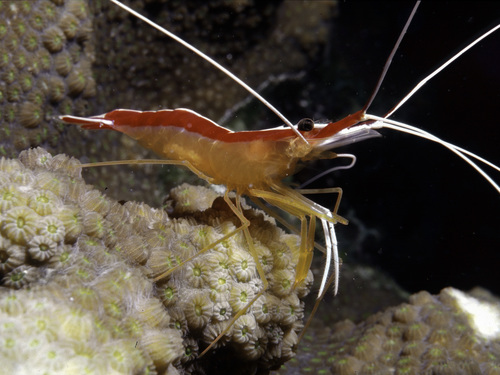
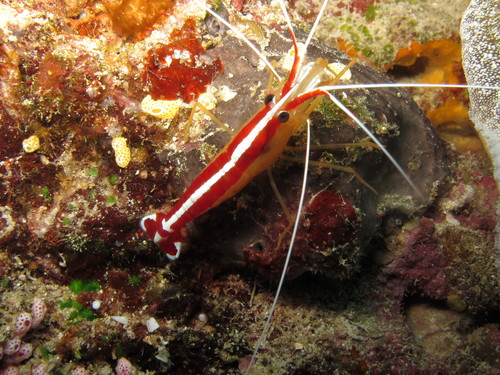
Description: Adult Lysmata amboinensis reach a body length of 2.5 to 3 inches, and have two pairs of long white antennae that measure 3 to 5 inches in length. The most anterior antenna forks into two, giving the shrimp the appearance of having three pairs of antennae. Their body and legs are pale amber, with longitudinal bands on the carapace: one central white band is bordered by wider scarlet red bands. The red tail has several symmetrical white spots. Like all decapods, this species has 10 pairs of walking legs, and the most anterior pair has forceps (pincers). Anterior to the walking legs sits a pair of white maxillipeds that the shrimp uses for feeding. Paired pleopods, also called swimmerets, sit underneath the thorax behind the walking legs, and are used for swimming and brooding eggs. Lysmata amboinensis has a pair of stalked eyes. Experiments indicate the species has coarse vision and is color blind; this low spatial resolution makes it unlikely that the shrimp can see the striking patterns of other shrimp or tropical fish.
Distribution and habitat: Lysmata amboinensis is native to tropical coral reefs, including those in the Red Sea and the Indo-Pacific Ocean. It inhabits tropical coral reefs at depths between 5 and 40 metres (16 to 131 ft), and is most commonly found in caves or on reef ledges.
Life cycle: Lysmata amboinensis lays eggs, which adult shrimp carry attached to their pleopods. Early larvae are called nauplii; after hatching, they develop into zoeae larvae that enter a free-floating planktonic stage. During this planktonic period, the larvae feed on other plankton and moult through 14 identified stages, growing to approximately 2 centimetres (0.79 in) over 5 to 6 months. After this growth period, the larvae settle and metamorphose into an immature mature form, which reaches full adult maturity after several additional moults that occur every 3 to 8 weeks.
Every Lysmata amboinensis shrimp begins life as a male, and becomes a hermaphrodite after a few moults. As hermaphrodites, they can function as both male and female when interacting with another shrimp, and the species has no pure female form. This pattern of sexual development is called protandric simultaneous hermaphroditism, and it is unique to Lysmata shrimp among other decapod crustaceans. In a single spawning, adult shrimp lay between 200 and 500 greenish eggs that are initially kept attached to the pleopods. Before hatching, the eggs swell and lighten in color, and a small number turn silver on the day of hatching. Eggs hatch around dusk, releasing larvae that are 3 to 4 millimetres (0.12 to 0.16 in) long into the free-floating pelagic zone.